$607M Wawayanda. 38 feet of height variance.
Amazon’s 3.2M sf Mid-Hudson mega-fulfillment died on a 38-foot height variance the town board couldn’t politically grant. Use classification traps. Environmental justice coalitions. Brand backlash. Industrial zones that don’t protect you. RealClear reads the corridor before you optimize. The review queue targets a delivery window confirmed at acceptance of the completed property submission. Complex or thin-record sites can take longer.
Truck routes are political. Use classifications are weapons. Forty years of zoning board discretion has made the industrial entitlement fight the most unpredictable in American real estate.
Who we built this for
Logistics REITs, industrial developers, last-mile fulfillment teams, and manufacturers screening large-footprint sites across multiple jurisdictions. A decision gate before deep diligence — not a replacement for in-house entitlement, legal, civil, traffic, environmental, or construction expertise.
On acceptance
Research target
12
States
$3.2B+
Projects stalled
5
Denial vectors
Delivery window confirmed when the completed property submission is accepted. Complex or thin-record sites may require more research.
Source document review · warehouses & logistics
The participants shaping warehouse outcomes.
Height variances, use-classification traps, and state-level environmental review. Three participants anchor the cited warehouse case-file record right now.
Wawayanda ZBA
Orange County, NY · unanimous denial
Coolbaugh Township ZHB
Monroe County, PA · upheld in court
Essex Junction DRB
Chittenden County, VT · 4-2 denial
Open any case file for the source documents, participant role, and method note behind the weighting.
Height variances, use-classification traps, state-level review.
The $607M Wawayanda project turned on 38 feet of height variance — and the denial was unanimous. The pattern anchors the cited warehouse record.
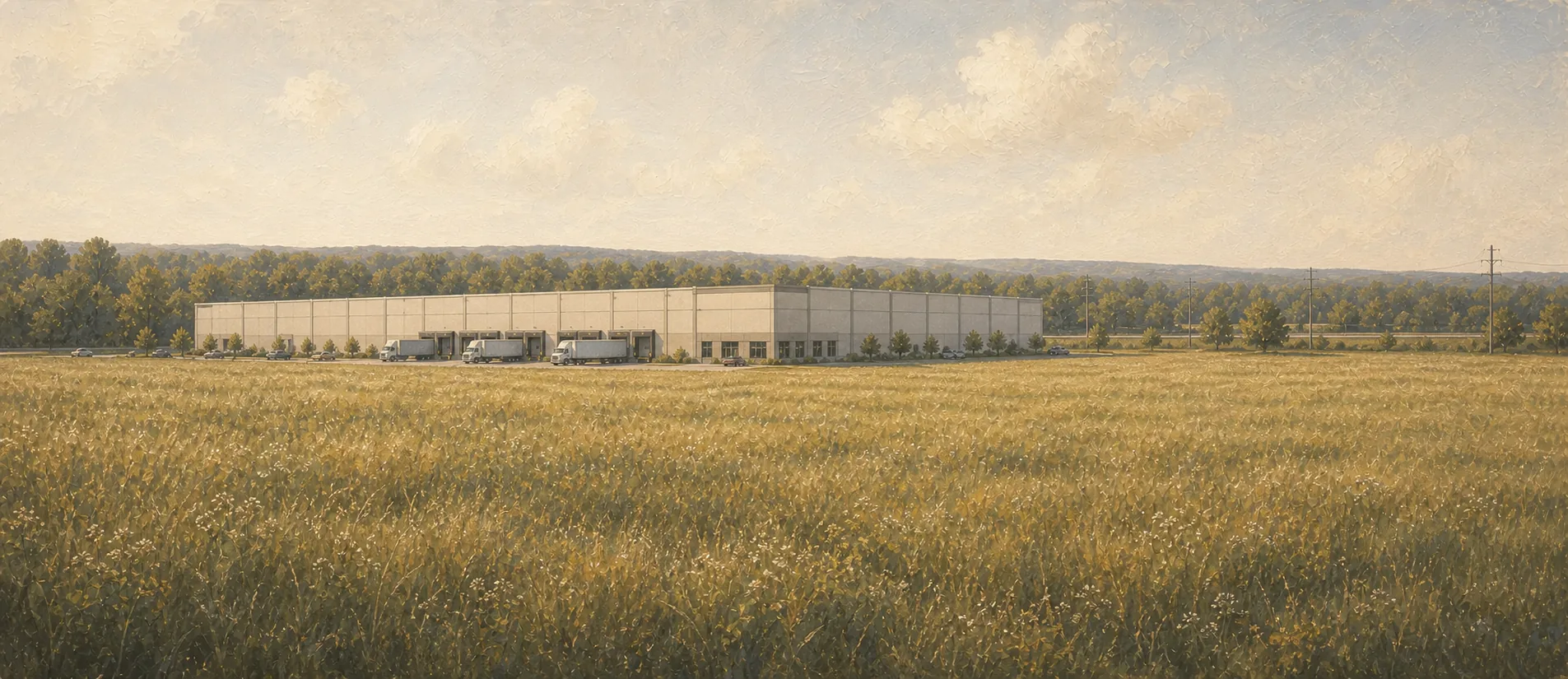
TRUCK COURTDOCK DOORSTREE SCREENINGOPEN FIELD
ILLUSTRATION · DISTRIBUTION SITE · NOT A SPECIFIC PROPERTYFive reasons a warehouse gets denied. None of them are about traffic.
Traffic studies are the visible part of the fight. Every one of these patterns ends a project before the traffic engineer is ever retained. RealClear flags all five before you commit site-control budget.
Use classification traps
The most expensive word in a zoning code is 'versus.' Coolbaugh Township denied 460,000 SF and 96 dock doors because the applicant filed as 'warehouse' — the code classified it as 'distribution center,' a prohibited use. Neither term appears in the lease. Both appear in the ordinance. For a submitted site, RealClear reads the defined terms before you file.
Environmental justice exposure
An EJ designation doesn't show up in the zoning map. It shows up at the hearing — in the form of a coalition with air-quality data, CEQA diesel-emissions analysis, and EPA Title VI standing. California's AB 98 and SB 415 add state-level restrictions that can override a local approval outright. The Fort Worth FedEx fight ran 40+ documented cancer-causing chemicals through a council hearing and still isn't finished.
Truck route restrictions and corridor moratoria
Truck route politics run years ahead of any specific application. A corridor marked for residential transition, a diesel ban in a nonattainment zone, a board-imposed moratorium on new truck terminals — none of these appear in the use table. All of them can kill a project after LOI. RealClear maps active moratoria, corridor designations, and truck route restrictions in the jurisdiction before the entitlement clock starts.
Industrial zone surprise downzonings
A planned industrial zone is not a guaranteed approval. Buckingham Township denied a 150,000 SF warehouse in its own designated industrial district — safety, traffic, quality of life. The board had discretion. They used it. Industrial zoning is a threshold condition, not a safe harbor. The gap between what the code permits and what the board will approve is where projects die.
Height and loading-bay variance math
$607 million. 3.2 million square feet. An $80 million tax break. Wawayanda's ZBA denied Amazon's mega-distribution campus unanimously — because the building was 103 feet tall against a 65-foot limit. Thirty-eight feet. A dimensional detail the traffic analysis, the SEQR, and the economic impact study couldn't overcome. RealClear flags height variances and loading-bay setback conflicts in the dimensional code before you lock the program.
22 industrial case files. Source documents linked.
Twelve states. Logistics REITs, last-mile fulfillment operators, EV manufacturers, and distribution centers. Every approval, denial, moratorium, and ongoing fight — tied to primary source documents, not search summaries.
How we read Wawayanda Amazon Mega.
In 2023, Amazon proposed a 3.2-million-square-foot distribution campus in Wawayanda, New York — a rural Orange County township with a 65-foot height limit in its industrial zone. The building was designed at 103 feet. The program required a 38-foot height variance from the Zoning Board of Appeals. Amazon arrived at the hearing with a $607-million project, an $80-million tax abatement negotiated with the local IDA, and an environmental impact statement that had cleared SEQR review. The ZBA denied the height variance unanimously.
The fight wasn’t about the economy. The township understood the tax base argument. The fight was about height — a dimensional detail that sat in the zoning code for decades before Amazon’s site team found the parcel. Community opposition mobilized around the visual bulk and the truck route corridor. At the ZBA hearing, the board didn’t need to weigh economic benefit against community character. They only needed to ask whether the applicant had demonstrated hardship sufficient to warrant a variance. They concluded it had not.
The EJ overlay complicated the picture further. The proposed site sat within proximity to a historically underserved census tract, and opposition organizers referenced diesel particulate exposure in their written record. The truck route question — how 1,400+ daily truck movements would enter and exit the campus — had no clean answer given the rural road network. The planning board’s SEQR sign-off didn’t bind the ZBA. The ZBA voted 5-0 against.
RealClear rates this site at 35 — deep red, high resistance. The dimensional conflict with the height limit was flagged in the zoning code read before any entitlement proceedings began. The truck route corridor fight was surfaced by scanning prior land use applications in Orange County. The EJ exposure score reflected census-tract demographics adjacent to the parcel. None of this required a public hearing. It required reading the record that already existed.
Every fight in the case-file library is a pattern your next site might match. Show us the parcel — we’ve seen this playbook.
Entitlement score
Location
Wawayanda, New York
Orange County · Hudson Valley
Do not commit the lease before the corridor fight is mapped.
Last-mile logistics meets first-mile opposition. Truck routes are political. Use classifications are weapons. RealClear reads the corridor before you optimize — zoning exposure, EJ score, truck route designation, community opposition history, and comparable outcomes in the jurisdiction. Dock doors and trailer parking count. The code reads differently than the lease.
“Industrial zoning is a threshold condition, not a safe harbor. The gap between what the code permits and what the board approves is where projects die.”
The review queue targets a delivery window confirmed at acceptance of the completed property submission. Complex or thin-record sites can take longer.