Skip to content
← Intelligence Library

RealClearThe evidence standard

No material claim without a source. No gap disguised as certainty.

A memo is a set of claims, each with a record behind it, checked against that record before it releases. This page shows the standard on the objects it is made of: a captured record, the exact excerpt, the claim that cites it, the review a delivered memo runs on them, the states that hold a memo, and the one sentence a gap is allowed to take.

01One claim, start to finish

The site area, from the City's parcel layer to a sentence with a footnote.

Four objects, in the order the research system produces them. The record is captured first, with its query and its time. The excerpt is the part of the record the claim rests on. The claim is written against the excerpt and footnoted to the record. In a delivered memo, automated citation review then reads the claim back against the excerpt before the memo can release; this sample was not run through it, so the fourth card shows the form of that row, not a result.

  1. Captured public recordS2

    City of Fullerton GIS, CommDev2 map service, layer 11 (Parcels)

    Publisher
    City of Fullerton
    Captured
    16 Oct 2026 05:33 UTC
    Locator
    attribute AREA_SF for the three APNs
    Status
    Read

    Proves the City's mapped area for each parcel: 7,125.81, 7,250.48 and 7,200.73 sf.

    Does not prove a surveyed area; the site address field was empty in the City layer and is taken from S1.

    Open the record ↗
  2. The exact excerptS2

    Layer 11 (Parcels), attribute AREA_SF, queried by the three assessment numbers

    APN 029-374-15 · AREA_SF 7125.80859624APN 029-374-14 · AREA_SF 7250.48180796APN 029-374-13 · AREA_SF 7200.73105715

    For a GIS layer the excerpt is the captured attribute record, kept with the query, the capture time and a hash of the raw response. The register notes that UPDATE_ is null, so the capture date stands for the publication date.

  3. The claim that cites itPublic record

    Three parcels, APNs 029-374-15, -14 and -13, at 601, 607 and 613 E Chapman Ave, with mapped areas of 7,126, 7,250 and 7,201 sf: 21,577 sf, or 0.495 acres, against the client's stated 0.49.1

    Section 1, Executive summary, first bullet under The site. The sum and the conversion to acres are computed from the admitted figures; the client's 0.49 is labelled as the client's.

    1City of Fullerton GIS layer 11recordAREA_SFlocatorcaptured 16 Oct 2026capture dateAppendix A, S2register row

  4. Automated citation review, the formPlaceholder · not run on this sample
    Checked
    In a delivered memo: the three mapped areas and their sum, as printed in the claim.
    Against
    The AREA_SF values in the S2 capture, re-read from the stored response.
    Outcome
    A claim that matches its excerpt stays declarative; one that cannot be matched is removed, not softened, and the memo does not release until every material claim has passed. This sample was not run through citation review: the row shows the form, not a result.

The footnote carries four parts, and each is checkable: the record, the locator inside it, the capture date, and the register row that says what the record proves and does not prove.

02The four classes of claim

Every sentence in a memo belongs to one class, and the class decides what may be said.

ClassWhat counts as a sourceWhat the memo prints when it is missingWho closes it
Public recordA source document with a locator, a capture date and a verbatim excerpt: a filing, an ordinance section, a GIS attribute, a staff report, minutes. The only class that may be stated declaratively.The sentence is not written. The gap prints as not established, with the party who closes it and how.The party named: the title company, counsel, a surveyor, the City in writing.
Client inputThe client's stated program (units, beds, acreage, use) and any document the client attaches. Always labelled as the client's.The memo asks. A program figure the client has not stated is not assumed.The client.
ComputedArithmetic the generator runs on admitted numbers and declared design assumptions, with every assumption printed next to its result so the line can be re-run.The input prints as an assumption, named as the specialist's to replace; in a sample it is marked as a placeholder.The specialist whose assumption it is: the architect, the civil engineer.
Model proseArgument, sequencing and emphasis written against the admitted set, the computations and the verdict rules. It may introduce no fact, number, name, vote or date that is not in the admitted set.Where the set is silent, prose emits the fixed gap sentence. Prose never closes a gap.No one. A sentence cannot stand in for a record.

Only the first class may be stated as fact. Model prose is the argument between the facts; it is written from the admitted set and may add nothing to it. Where the set is silent, prose emits the gap sentence in section 04 rather than an opinion. The memo's content model calls these four the admitted claim, the client input, the deterministic computation and the model prose; the names here are the reader's.

03What holds a memo

Two things stop a memo, and one holds its verdict, and the product says which.

A memo waits when a material claim is below the admission floor or cannot be matched to its source; the status in the workspace names the check it has not cleared. A controlling fact the record does not contain does not hold the memo: the memo releases, the verdict stays at Resolve first, and the memo names who closes it.

Below the admission floorNot released: citation checks
What happened
A material claim reached the memo without a source document, a locator, a capture date and an excerpt: the floor every admitted claim must clear.
What the memo does
The claim is removed. If the verdict rested on it, the memo does not release; the research run goes back for the record or the gap is printed in its place.
What you see
The property's status reads Not released: citation checks until the material set is whole. No draft leaves the workspace.
A source the verifier could not matchNot released: citation checks
What happened
Automated citation review could not match a material claim to the excerpt of its source: the document would not open, the passage was not there, or the number differed.
What the memo does
The claim is removed, not softened into a hedge. The certification reports review coverage; it must be 100 percent of material claims before release.
What you see
The same hold label, with the edition withheld, until the claim is re-sourced or removed.
A controlling fact the record does not containReleased
What happened
A route-deciding fact the public record does not carry, such as the right-of-way width the AB 2011 test turns on, or the Plan's corridor text that was not read.
What the memo does
The verdict cannot be Pursue or Pass. The memo releases as Resolve first, prints the gap sentence with its owner, and names the document that would move the verdict.
What you see
A released memo with an open gate and a next-steps table. When the result is attached the memo re-issues as a new edition. Monitor is the watch state after the decision, not a verdict.

A released memo ends in one of three verdicts. Pursue: The route is open and the decisive facts are cited. Resolve first: At least one route-deciding gate is open, and the memo names who closes it. Pass: Cited claims prove failure on every route in scope. Monitor is the watch state after the decision, not a verdict.

04The one sentence a gap may take

Not established: what, who closes it, how.

Where the record is silent on something the decision needs, the memo says so in one sentence of fixed form. Three from the Fullerton memo: two in the fixed form, as printed; the third as the memo states it in prose, as printed.

Not established. What stands on the lots today, whether any tenancy is residential, and who holds title. The client's title company closes title and the merger path with preliminary reports on all three APNs; counsel closes lawful existing use and any relocation obligation from certificates of occupancy, business licences and leases (Section 12, items 3 and 4).
Section 3, under Table 1.
Not established. whether the Plan's policies encourage housing on the corridor, which would help an amendment, or reserve the frontage for employment, which would hurt one, is not established; counsel closes this with the pre-application meeting.
Section 4, The General Plan, as printed: the memo states this gap in prose rather than the fixed form, because the Plan's corridor text was not read for this edition (Appendix A, S5).
Not established. The Council's and Commission's votes and stated positions on corridor housing since 2024. Counsel reads the minutes before the pre-application meeting (Section 12, item 2); RealClear's delivered edition cites them.
Section 9, Community and political record. The hearing record was not read for this edition (Appendix A, S13).

05A placeholder is a label, not a licence

A figure not drawn from a cited record is marked, and a delivered memo carries none.

The sample memo marks 42 figures as placeholders in its footnotes: standards captured for an earlier edition and not re-read, every processing duration, all of its market and comparables sections. Each one is hatched and tagged in the page itself. In a delivered memo the figure is cited or the sentence prints not established; the tag does not exist.

Step 01A footnote

A footnote is a record, a locator, a capture date and a register row.

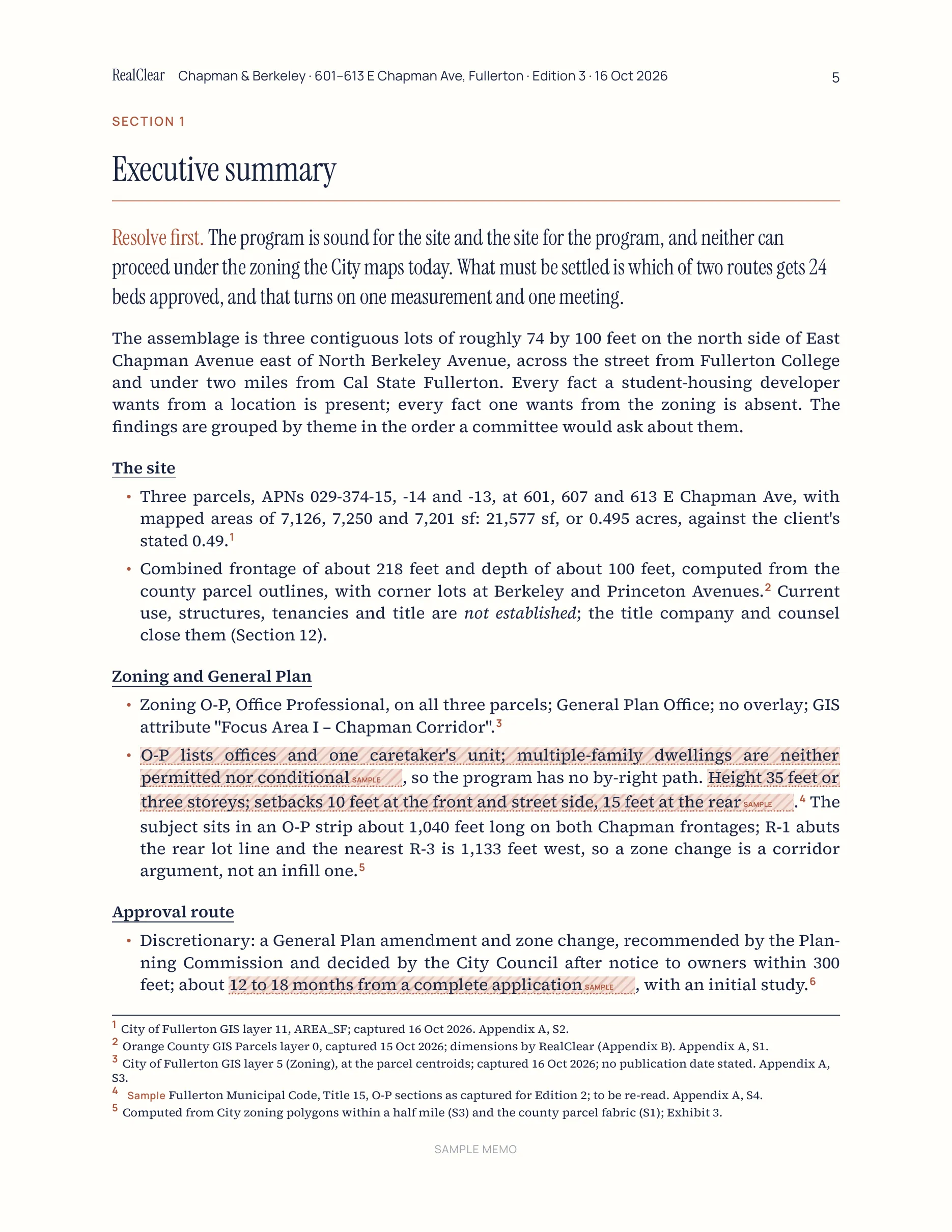
Page 5 of the sample memo for 601–613 E Chapman Ave, Fullerton: Section 1 · Executive summary, footnotes
Page 5 of 35Section 1 · Executive summary, footnotes601–613 E Chapman Ave, Fullerton · Edition 3

Marked as placeholders in the page itself: nothing in this part of the page. Elsewhere on page 5: O-P lists offices and one caretaker's unit; multiple-family dwellings are neither permitted nor conditional · Height 35 feet or three storeys; setbacks 10 feet at the front and street side, 15 feet at the rear · 12 to 18 months from a complete application.

This is the unit everything else is built from. The claim in the summary says the three parcels total 21,577 square feet; footnote 1 says where that number was read, in which field, on which day, and which register row explains what the source proves and does not. Automated citation review checks the claim against the excerpt of that source before the memo can release; a claim that fails is removed.

Four footnotes down is the one footnote on this page that flags its figures as placeholders: the standards it would cite were captured for an earlier edition and not re-read, which is why the clauses it supports are hatched above. In a delivered memo that footnote cites the code section and its capture, or the claim is not there at all.

Step 02The source register

Every source says what it proves, what it does not, and whether it was read.

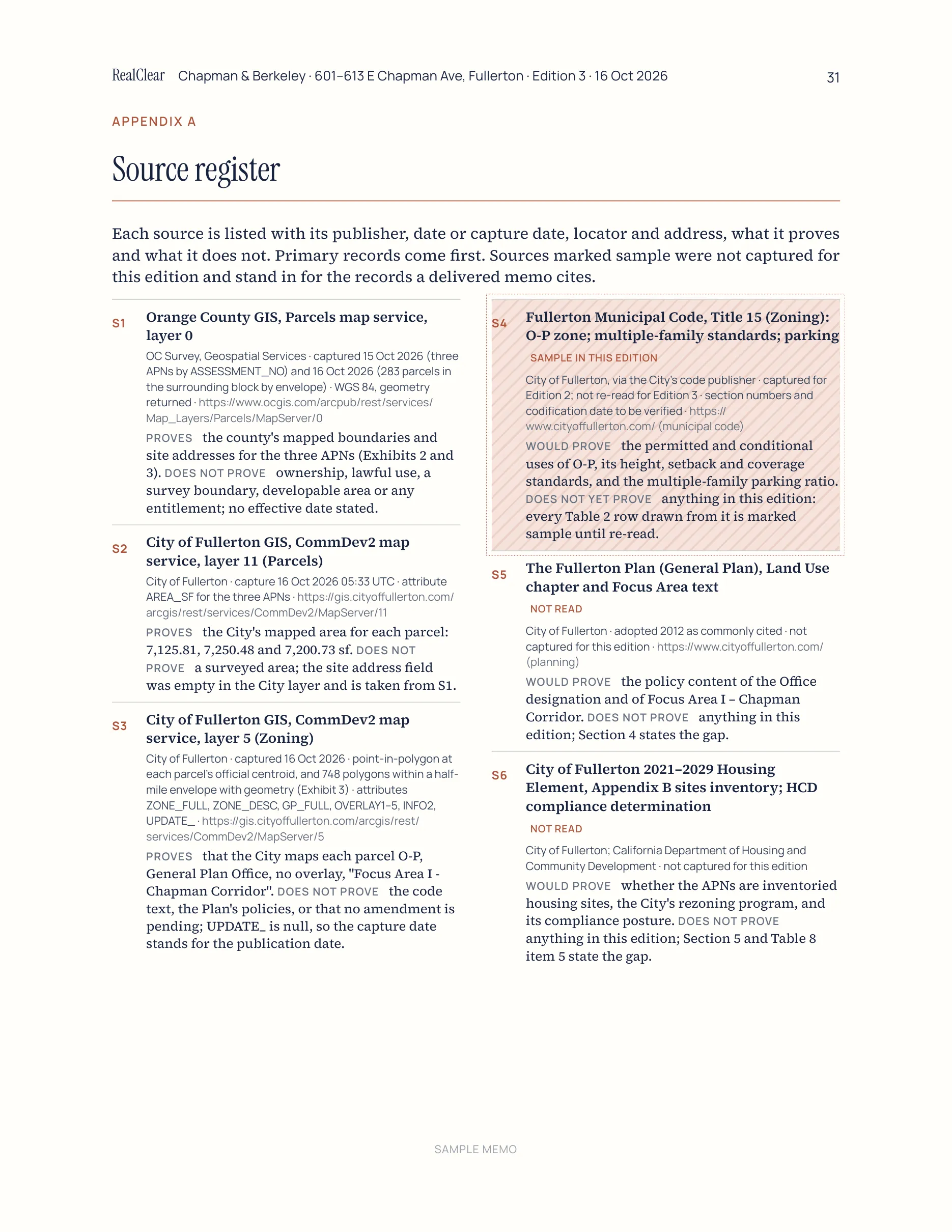
Page 31 of the sample memo for 601–613 E Chapman Ave, Fullerton: Appendix A · Source register
Page 31 of 35Appendix A · Source register601–613 E Chapman Ave, Fullerton · Edition 3

Marked as placeholders in the page itself: SAMPLE IN THIS EDITION. Hatched and tagged in the pixels; a delivered memo cites the record where each one stands, or prints not established.

The register is where a sceptical reader goes first, so it is written for one. Each row carries a status: read, not read, or placeholder. A not-read source still appears, with what it would prove, because its absence is part of the finding. A placeholder source, S4 here, is hatched in this sample because a delivered memo would either have captured it or dropped every claim that depends on it.

The proves and does-not-prove lines are the register's real work. They stop a source being cited for more than it says: a parcel layer proves a mapped boundary and nothing about title; a captured statute proves its text on the capture date and nothing about how a city applies it.

06Editions

A memo is a reading of the record on a date, re-issued when the record moves.

Edition. 3 of 16 October 2026, superseding Edition 2 of 6 October 2026, which released with one cited source and is withdrawn.

The running head on every page names the edition and its date; the certification carries the edition line above, naming what it supersedes and why: that is the form, shown here as the sample prints it. When a next-steps result is attached a delivered memo re-issues as a new edition, and the old one is withdrawn rather than edited. Monitor is the watch state after the decision, not a verdict.

For your property

The standard is the same for every property we read.

Bring one property. The memo you receive is built from your jurisdiction's record to this standard, and says plainly where that record stops.

Bring us a property