RealClearHow to read a site memo
How to read a RealClear site memo.
Walked through on a sample memo, built by hand in the exact format a delivered memo uses, page by page: the verdict and the three facts that decide it, a footnote and the record behind it, the parcel map and the corridor test, the developer's arithmetic, the risks, and what would change the answer.
- Property
- 601–613 E Chapman Ave, Fullerton
- Edition
- Edition 3 · 16 October 2026
- Length
- 35 pages · 16 sources
- Verdict
- Resolve first
A memo ends in one of three verdicts
- Pursue The route is open and the decisive facts are cited.
- Resolve first At least one route-deciding gate is open, and the memo names who closes it.
- Pass Cited claims prove failure on every route in scope.
Monitor is the watch state after the decision, not a verdict.
Step 01The letter
The verdict comes first, and the three facts that decide it come next.
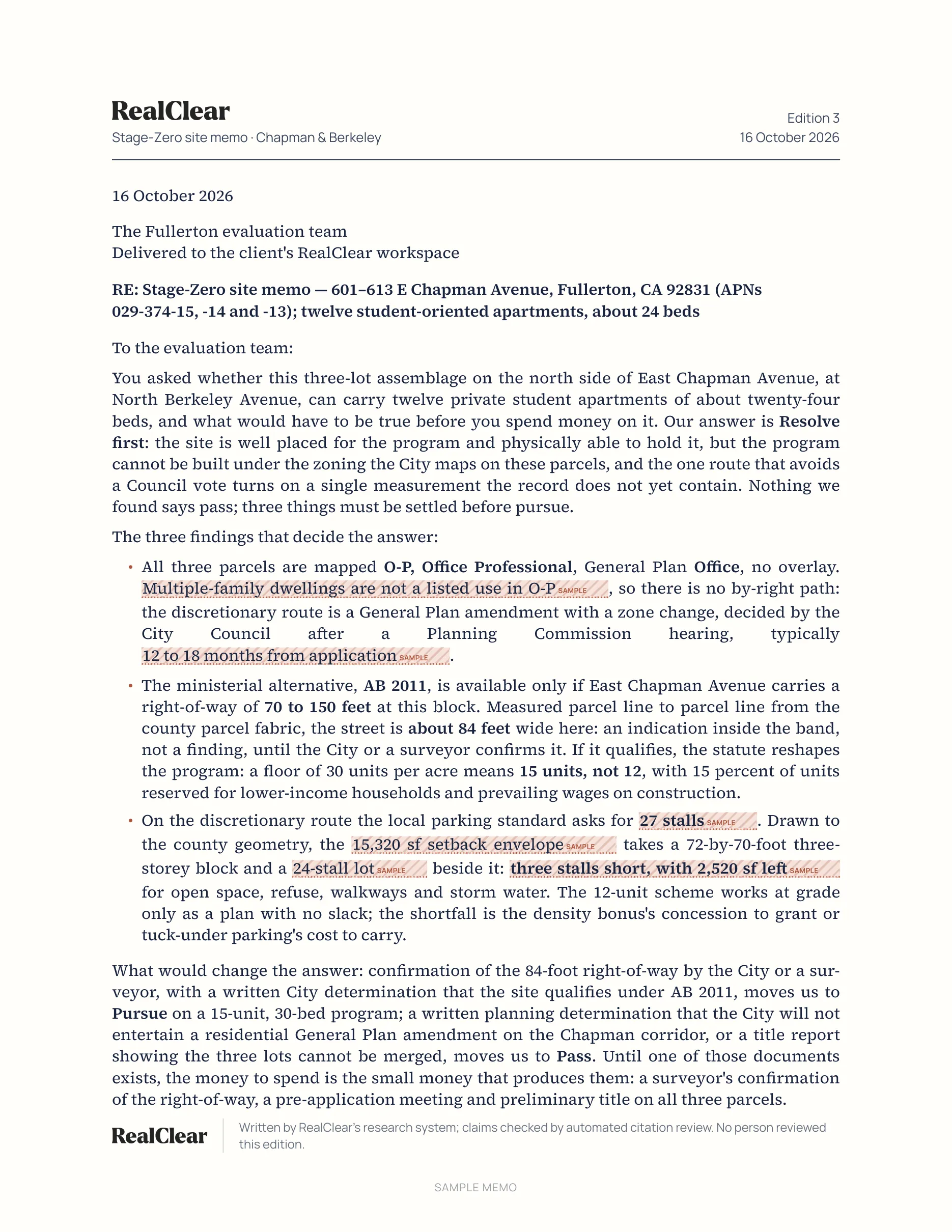
Marked as placeholders in the page itself: not a listed use in O-P · 12 to 18 months from application · 27 stalls · 15,320 sf setback envelope · 24-stall lot · three stalls short, with 2,520 sf left. Hatched and tagged in the pixels; a delivered memo cites the record where each one stands, or prints not established.
A site memo is a letter before it is a report. The first paragraph restates the question and answers it in one of three words: Pursue, Resolve first, or Pass. Here it is Resolve first, and the letter says why in the same breath: the program cannot be built under the mapped zoning, and the one route that avoids a Council vote turns on a measurement the record does not yet contain.
Then three findings, each an admitted claim with its number, and then the paragraph a committee actually argues about: what would change the answer. Notice that it names documents, not opinions. A surveyor's confirmation and a written City determination move this to Pursue; a written refusal or a title report that blocks the merger moves it to Pass.
Step 02The certification
Five statements that say exactly how much to trust what follows.
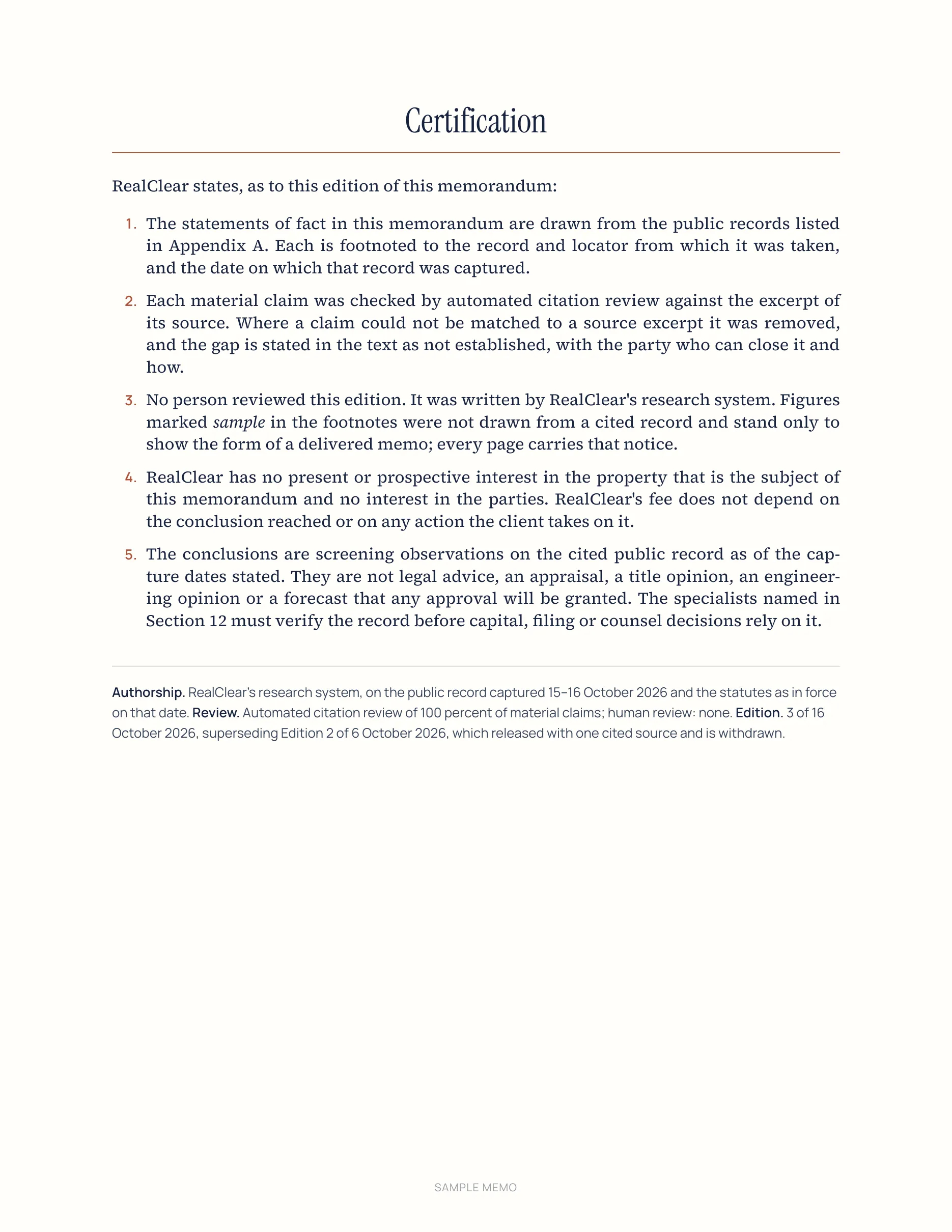
Marked as placeholders in the page itself: nothing on this page. Every figure here is drawn from a cited record or is a computation on one.
The certification is not boilerplate; it is the standard the memo will be held to, printed where a reader can hold it there. Statement 2 is the one that matters most: a claim that cannot be matched to a source excerpt is removed, not softened into a hedge. Statement 3 says plainly that no person reviewed the edition, and that a figure marked in the footnotes is a placeholder.
The last block turns the standard into fields a reader can check: the capture-date range, the share of material claims that passed review (it must be 100 percent for a memo to release), and the edition line, including what the edition supersedes. Read it here as the form a delivered certification takes; this sample was written by hand and the review it names did not run.
Step 03The executive summary
The summary repeats the verdict, then groups what is known by the question a committee asks.
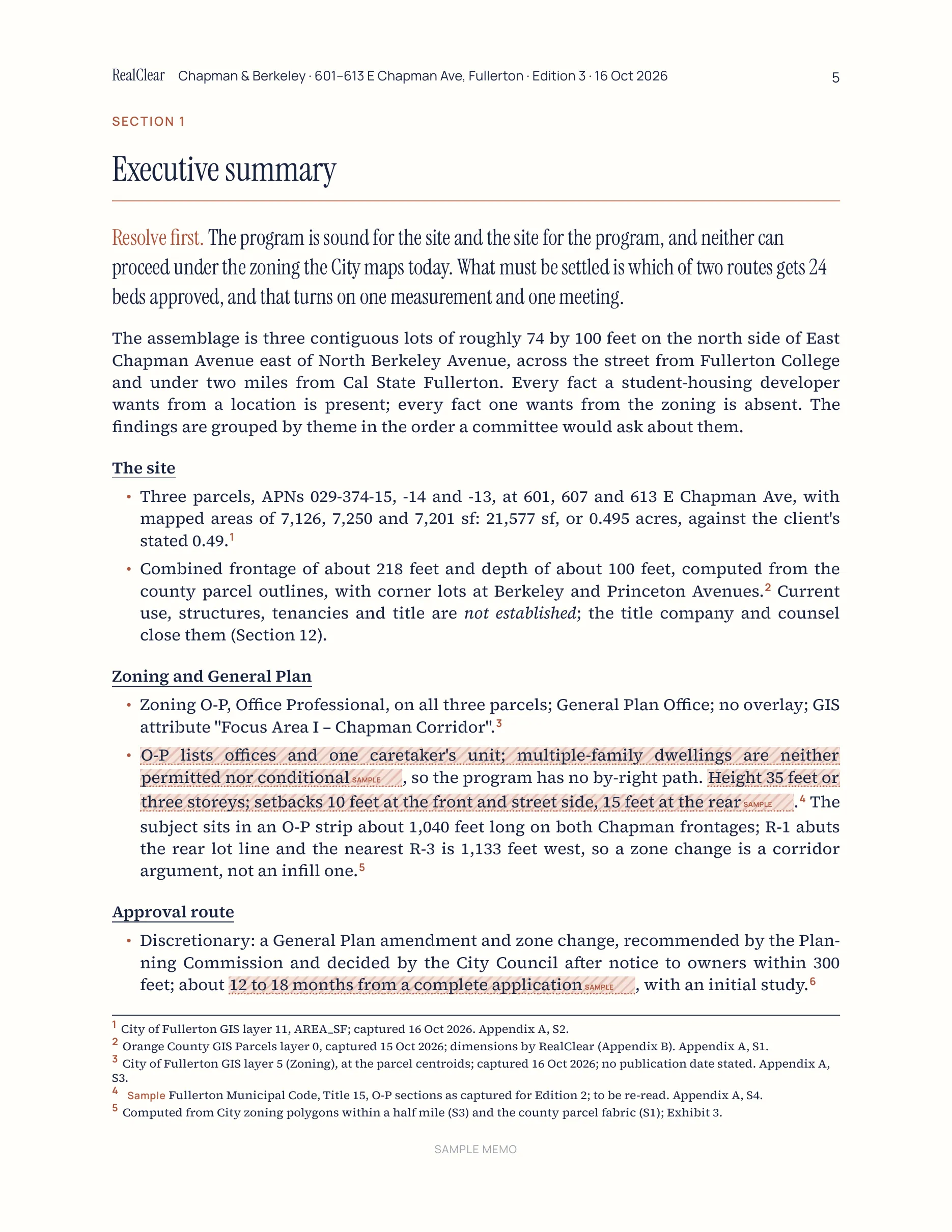
Marked as placeholders in the page itself: O-P lists offices and one caretaker's unit; multiple-family dwellings are neither permitted nor conditional · Height 35 feet or three storeys; setbacks 10 feet at the front and street side, 15 feet at the rear · 12 to 18 months from a complete application. Hatched and tagged in the pixels; a delivered memo cites the record where each one stands, or prints not established.
The summary is the page most readers stop at, so it is built to survive that. It repeats the verdict in the memo's own words, then runs through the themes in the order a committee asks about them. Every bullet must carry at least one figure and one footnote; a theme the record does not support gets a single sentence saying so.
The hatched clauses in the zoning bullet and the duration in the approval-route bullet are the figures on this page that rest on standards captured for an earlier edition and not re-read, or on no record at all; the memo marks them as placeholders in its footnotes, and the tag sits on each one in the page itself. A delivered memo cites the code section there, or prints not established.
Step 04A footnote
A footnote is a record, a locator, a capture date and a register row.
Marked as placeholders in the page itself: nothing in this part of the page. Elsewhere on page 5: O-P lists offices and one caretaker's unit; multiple-family dwellings are neither permitted nor conditional · Height 35 feet or three storeys; setbacks 10 feet at the front and street side, 15 feet at the rear · 12 to 18 months from a complete application.
This is the unit everything else is built from. The claim in the summary says the three parcels total 21,577 square feet; footnote 1 says where that number was read, in which field, on which day, and which register row explains what the source proves and does not. Automated citation review checks the claim against the excerpt of that source before the memo can release; a claim that fails is removed.
Four footnotes down is the one footnote on this page that flags its figures as placeholders: the standards it would cite were captured for an earlier edition and not re-read, which is why the clauses it supports are hatched above. In a delivered memo that footnote cites the code section and its capture, or the claim is not there at all.
Step 05The parcel map
The parcels are drawn from county geometry, and what the record does not say is said out loud.
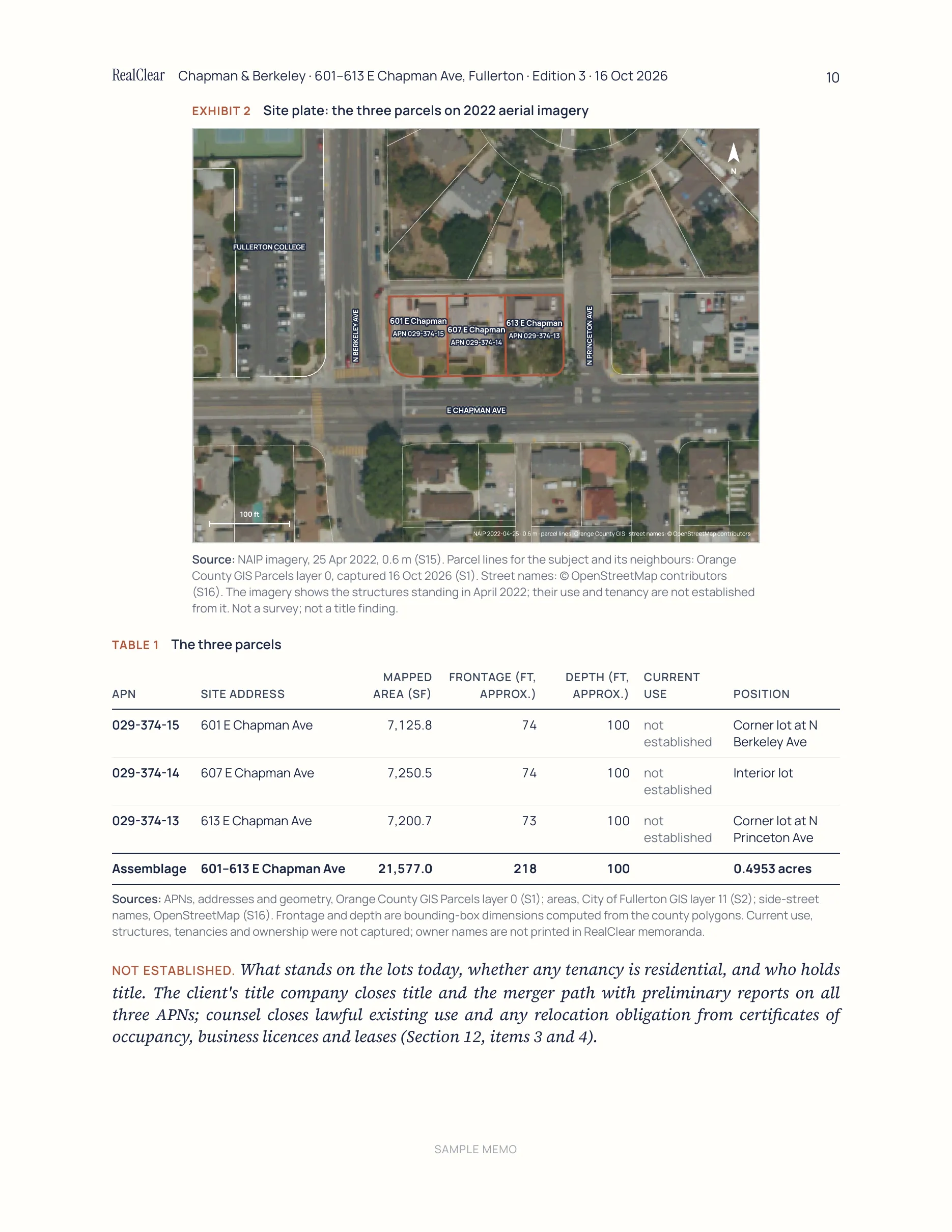
Marked as placeholders in the page itself: nothing on this page. Every figure here is drawn from a cited record or is a computation on one.
A map in a memo is cited geometry. The three polygons are the county's, drawn without simplification; the areas are the City's; the street names are OpenStreetMap's because the county record carries none. Each of those is a source in Appendix A, and the exhibit's Source line names them.
Table 1 shows the discipline on a table: a column the record does not fill prints not established rather than a guess. The sentence under the table is the form every gap takes in a RealClear memo: what is missing, who closes it, and how.
Step 06The zoning finding
A finding drawn from absence says so, and the optimistic reading is tested in print.
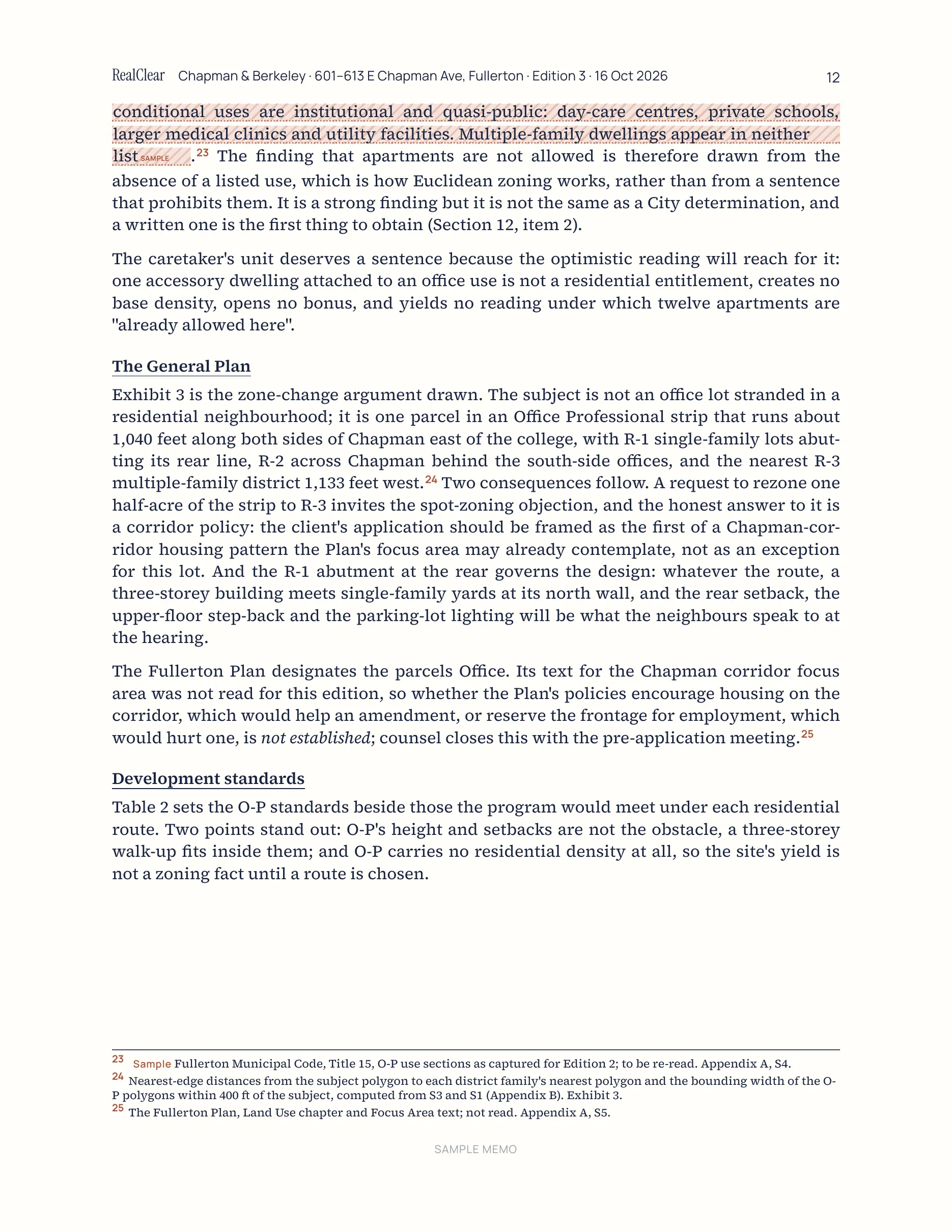
Marked as placeholders in the page itself: Multiple-family dwellings appear in neither list. Hatched and tagged in the pixels; a delivered memo cites the record where each one stands, or prints not established.
Euclidean zoning works by lists, so the decisive finding here is an absence: the use is not on either list. The memo does not dress that up. It says the finding is drawn from absence, that it is strong, and that it is still not the same as a City determination.
Then it does the committee's adversarial work for it. The caretaker's-unit sentence exists because someone will raise it; the General Plan paragraph ends in not established because the Plan's text was not read for this edition, and says so. The use list itself was captured for Edition 2 and not re-read, which is why the sample hatches it where it is quoted and marks footnote 23 as a placeholder.
Step 07The approval route
One diagram, one open question, two dead lanes.
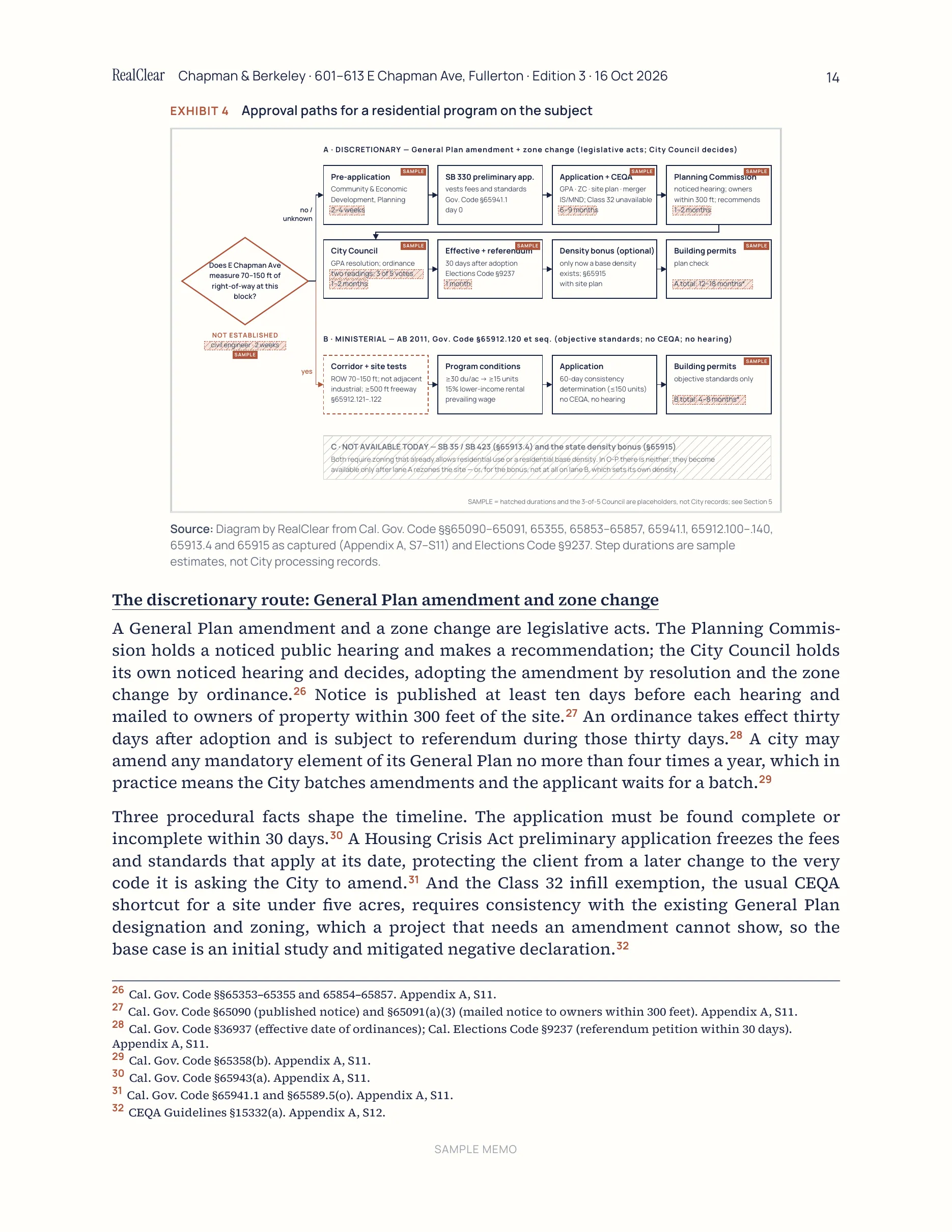
Marked as placeholders in the page itself: 2–4 weeks · 6–9 months · 1–2 months · two readings; 3 of 5 votes · 1 month · A total: 12–18 months* · B total: 4–8 months* · civil engineer · 2 weeks. Hatched and tagged in the pixels; a delivered memo cites the record where each one stands, or prints not established.
The route diagram is generated from the route tests: each statutory test resolves to met, not met, or not established from admitted facts, and the open test is drawn as the diamond. Here only one is open, and it is a width.
The durations in the boxes are hatched, with a SAMPLE chip on every box that carries one, because they are declared assumptions, not Fullerton's processing records, which were not captured; so is the 3-of-5 Council. In a delivered memo those boxes carry the jurisdiction's own figures with a citation, or no figure at all; a memo never promises a timeline it has not read.
Step 08The corridor test
A measurement is reported as an indication, and the gate stays open until a record closes it.
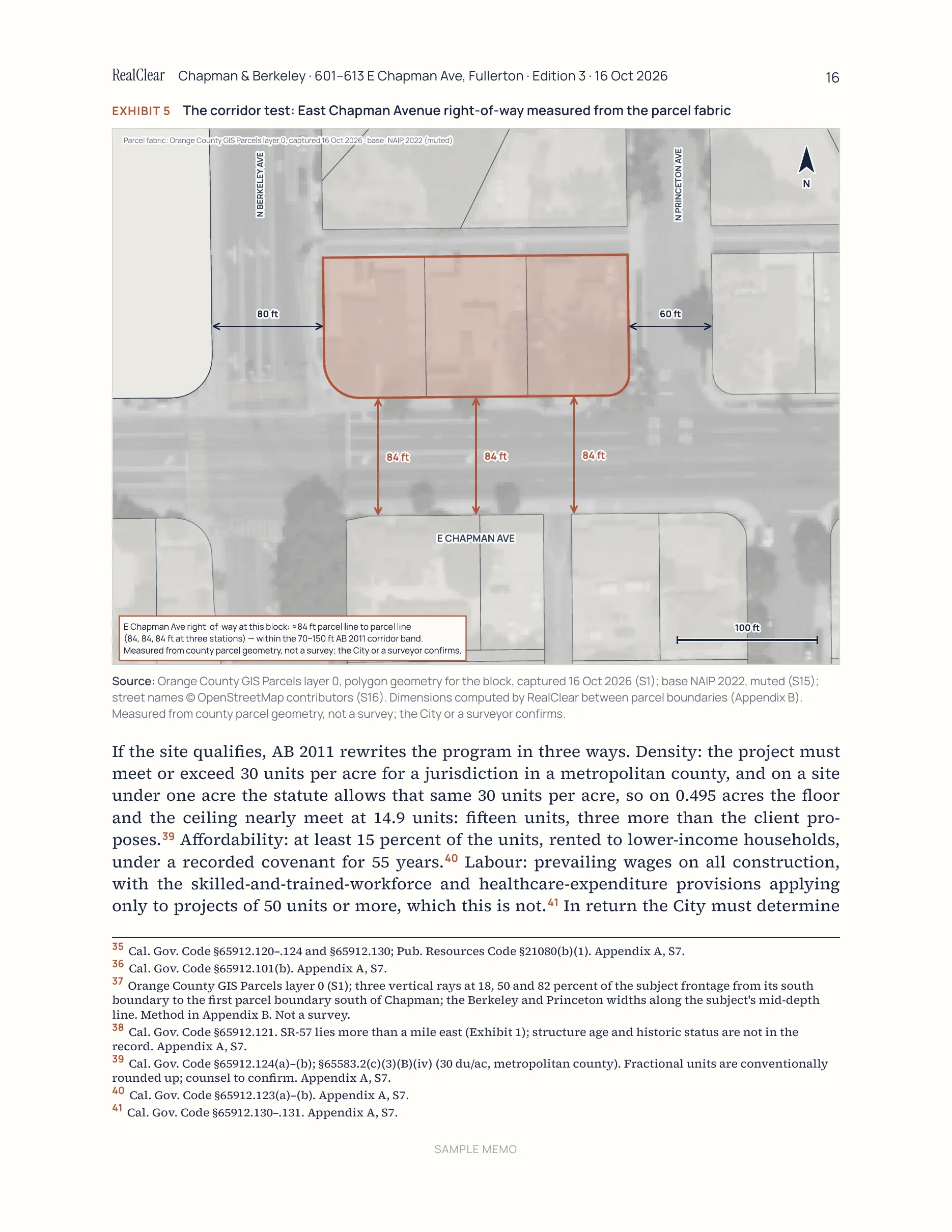
Marked as placeholders in the page itself: nothing on this page. Every figure here is drawn from a cited record or is a computation on one.
This is the page the verdict turns on, so look at how carefully it is worded. The measurement is real, deterministic and reproducible: three rays across the parcel fabric, each 84 feet. The memo still calls it an indication, because the statute's test is satisfied by a record (a City street classification or a survey), not by geometry alone.
That distinction is the whole method in one exhibit. A measurement that bears on a statutory test is reported toward the test; the test itself stays not established until a cited record closes it, and the memo names who does that and roughly what it costs.
Step 09Transit and parking
A geometric test is run as geometry; the part that needs a schedule is left open.
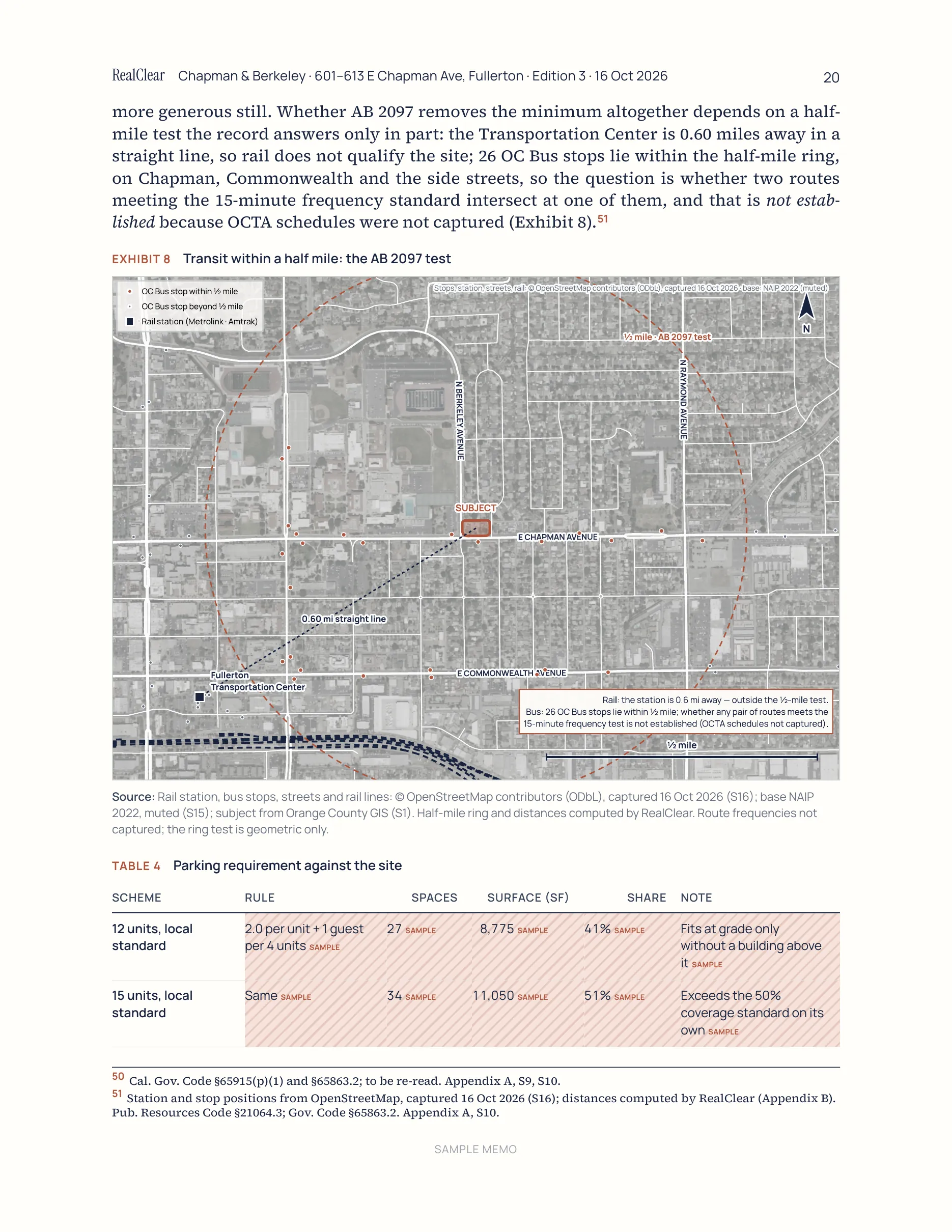
Marked as placeholders in the page itself: 2.0 per unit + 1 guest per 4 units · 27 · 8,775 · 41% · Fits at grade only without a building above it · Same · 34 · 11,050 · 51% · Exceeds the 50% coverage standard on its own. Hatched and tagged in the pixels; a delivered memo cites the record where each one stands, or prints not established.
Two tests share this page and the memo treats them differently on purpose. The half-mile ring is pure geometry on frozen OpenStreetMap data, so it is run and drawn. The frequency half of the same statute needs a timetable the research did not capture, so that half prints not established instead of an assumption.
Table 4 then does the developer's arithmetic in the open. One of its inputs, the local parking ratio, is marked as a placeholder in this sample, and so is everything computed from it; the arithmetic is still shown, with the method, so a committee can swap the input and re-run the line.
Step 10The site plans
The arithmetic is drawn to the county geometry, with every assumption named as the architect's to replace.
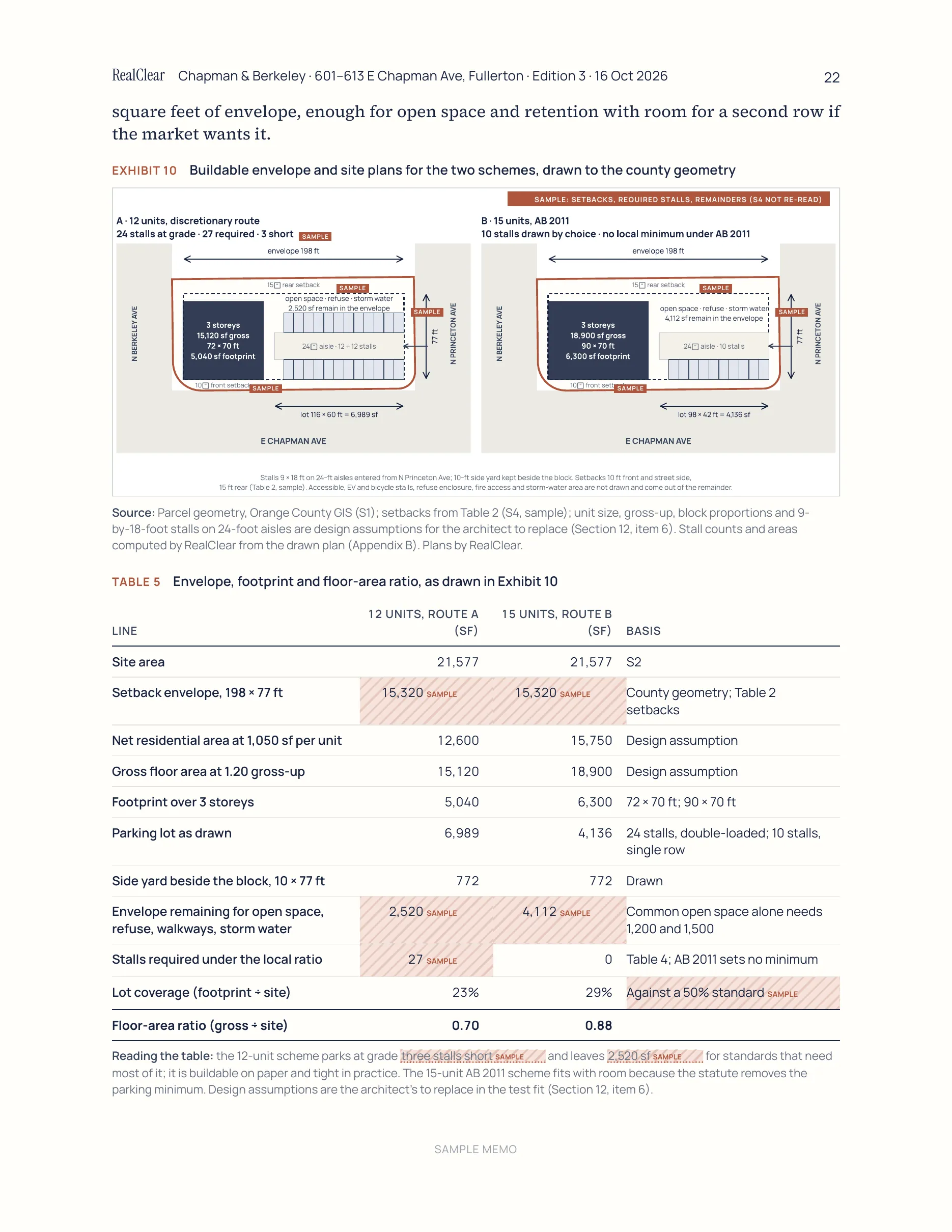
Marked as placeholders in the page itself: SAMPLE: SETBACKS, REQUIRED STALLS, REMAINDERS (S4 NOT RE-READ) · 15,320 · 2,520 · 4,112 · 27 · Against a 50% standard · three stalls short · 2,520 sf. Hatched and tagged in the pixels; a delivered memo cites the record where each one stands, or prints not established.
Development capacity is computed, not asserted. The envelope is the union of the county polygons shrunk by the setbacks; the block is the gross floor area divided by storeys; the stalls fill what is left at a declared size. Every number in Table 5 prints the input it came from, so the architect's test fit replaces the assumptions one line at a time.
The hatched cells, and the chip on the exhibit, mark what rests on standards captured for an earlier edition and not re-read: the setbacks, and so the envelope and what remains of it, the required stalls, and the lot-coverage standard. The reading-the-table sentence still holds in a delivered memo, because the method does; only the inputs change.
Step 11The risk register
The register is rated before and after mitigation, with an owner on every line.
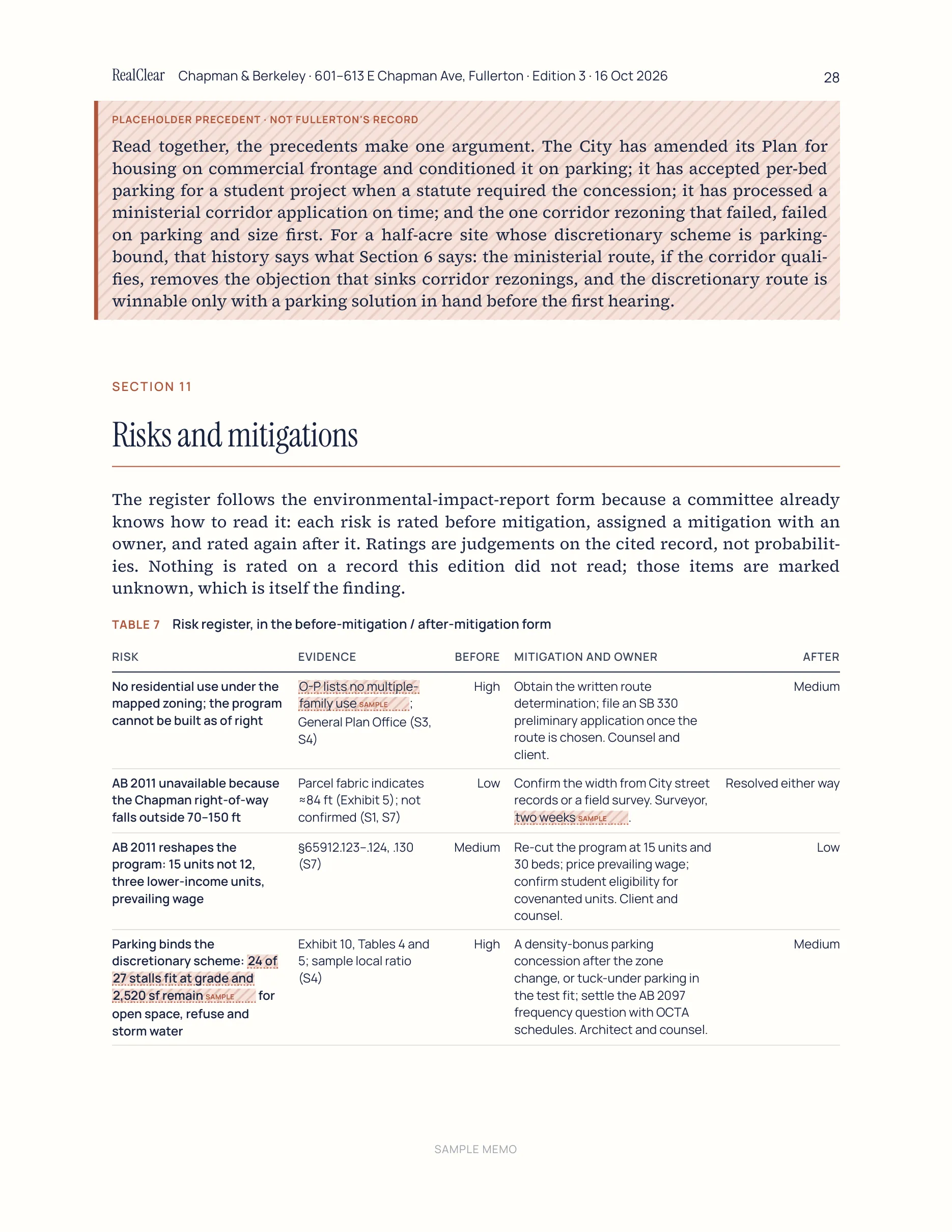
Marked as placeholders in the page itself: Read together, the precedents make one argument · O-P lists no multiple-family use · two weeks · 24 of 27 stalls fit at grade and 2,520 sf remain. Hatched and tagged in the pixels; a delivered memo cites the record where each one stands, or prints not established.
Read the register right to left. The After column tells you what the risk looks like once someone has done the named work; the Mitigation column tells you who and what; the Evidence column tells you whether the rating rests on a claim or on a gap. A rating that rests on a gap is Unknown by rule, not by judgement.
Two things are marked on this page. The opening paragraph sums up Section 10's placeholder precedents, so it carries the placeholder tag in the page itself; and the register's figures that rest on the use list and the parking ratio this sample did not re-read are hatched. The ratings and the mitigations stand on the arithmetic either way.
Step 12What would change the answer
Unknown is assigned by rule, and the memo names the documents that would move the verdict.
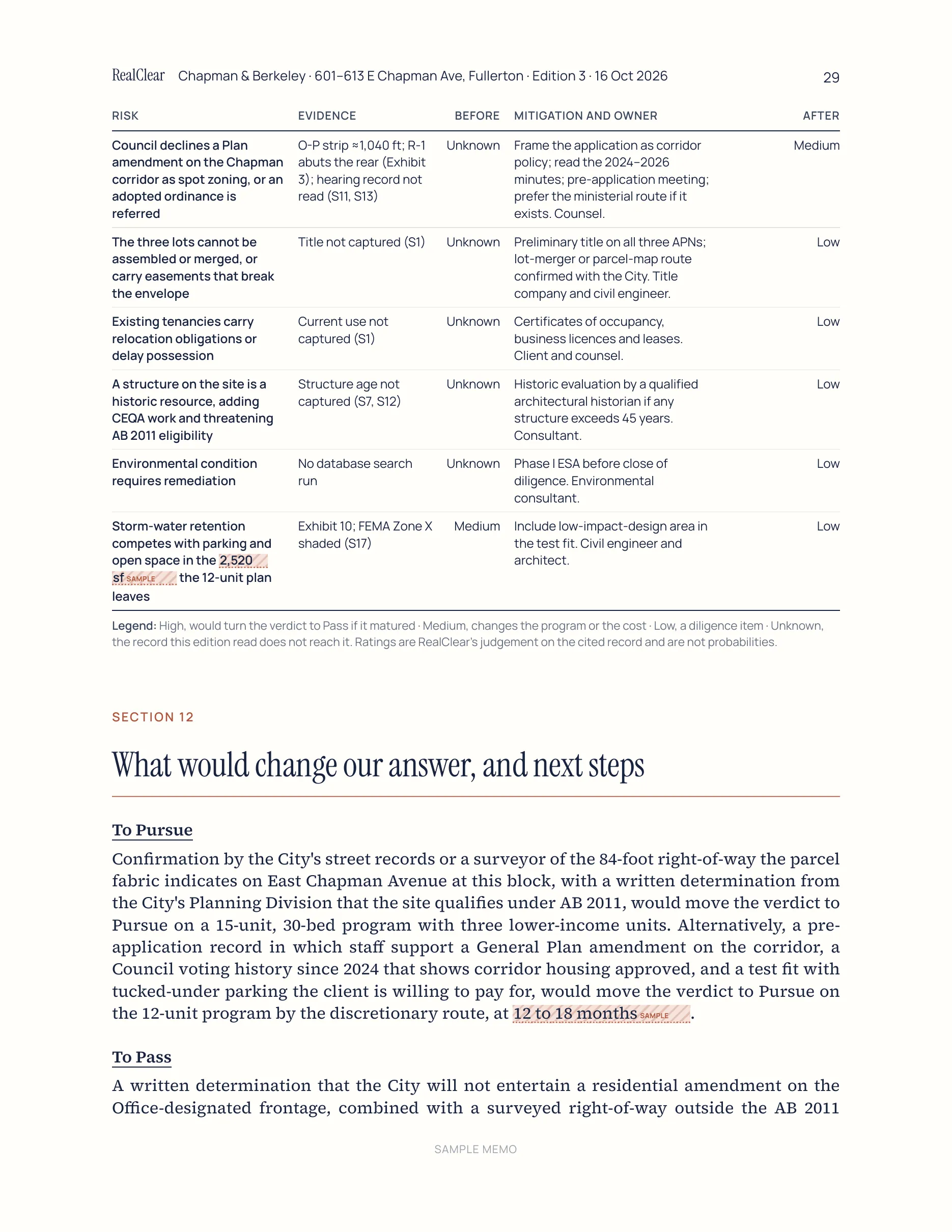
Marked as placeholders in the page itself: 2,520 sf · 12 to 18 months. Hatched and tagged in the pixels; a delivered memo cites the record where each one stands, or prints not established.
Section 12 is the memo's answer to the only question a committee needs answered after the verdict: what would change it. The triggers are derived from the route tests, so each one is a document, and each document has an owner in the table that follows.
Notice the verbs. The memo does not forecast that the City will or will not act; it says which record would move the verdict and which professional produces that record. The judgement stays Resolve first until one of those exists.
Step 13The source register
Every source says what it proves, what it does not, and whether it was read.
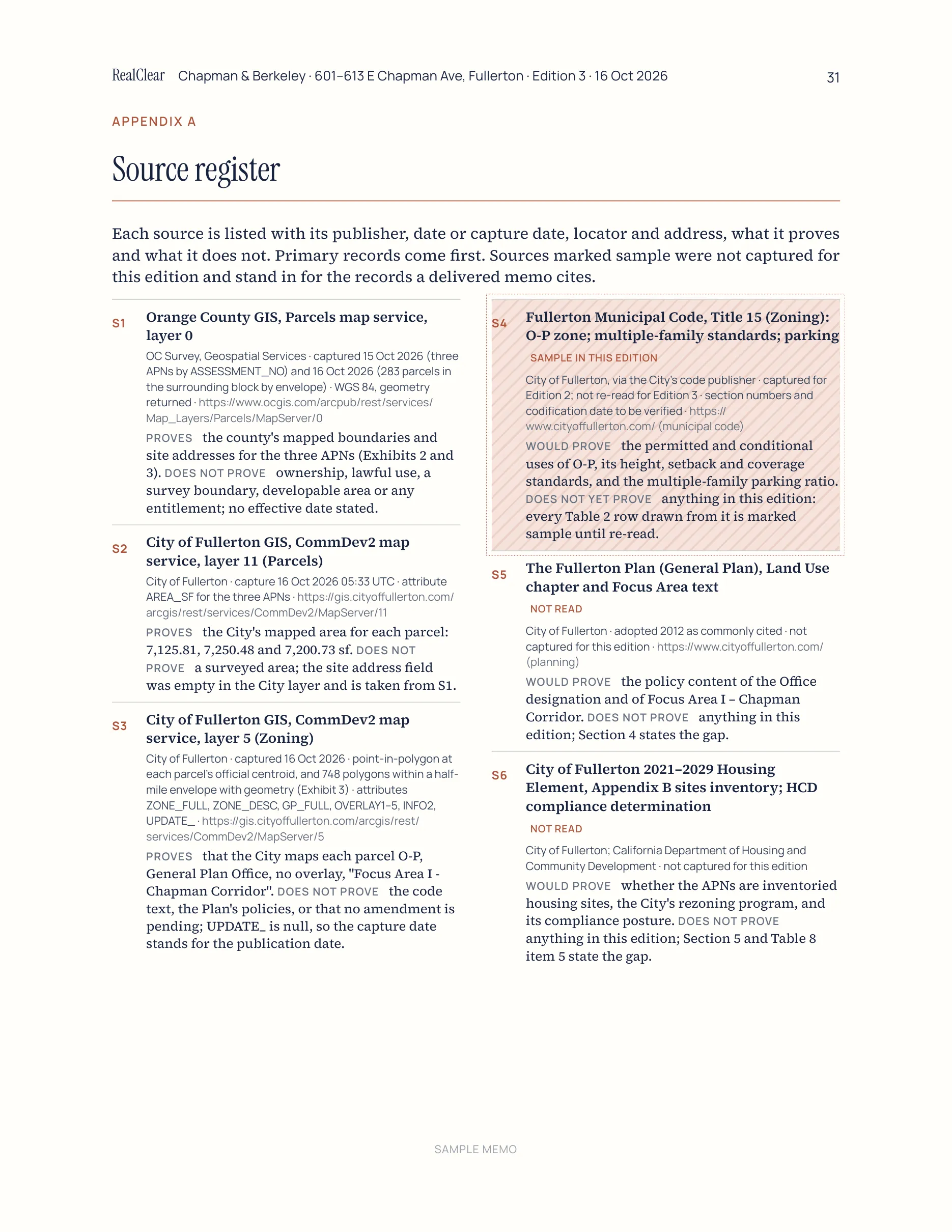
Marked as placeholders in the page itself: SAMPLE IN THIS EDITION. Hatched and tagged in the pixels; a delivered memo cites the record where each one stands, or prints not established.
The register is where a sceptical reader goes first, so it is written for one. Each row carries a status: read, not read, or placeholder. A not-read source still appears, with what it would prove, because its absence is part of the finding. A placeholder source, S4 here, is hatched in this sample because a delivered memo would either have captured it or dropped every claim that depends on it.
The proves and does-not-prove lines are the register's real work. They stop a source being cited for more than it says: a parcel layer proves a mapped boundary and nothing about title; a captured statute proves its text on the capture date and nothing about how a city applies it.
For your property
Your memo will differ in every fact and in none of the discipline.
Bring one property. The memo you receive is held to the standard this sample shows: built from the public record of your jurisdiction, footnoted to the capture, checked by automated citation review before it releases, and plain about what the record does not establish.
Bring us a property