150 pads to screen. Stack, access, and traffic questions in half of them.
Know which ones before LOI.
Submit the parcel, site format, drive-thru need, and what you're trying to decide. RealClear returns a cited site memo on pad viability: use permission, stacking exposure, access conflicts, traffic-confirmation questions, hours, overlays, and comparable outcomes.
Delivery window confirmed when the completed property submission is accepted. Complex or thin-record sites may require more research.
Source document review · QSR & drive-thru
The participants shaping drive-thru outcomes.
Same council, same ordinance, opposite results. The Raising Cane's 4-2 approval and the In-N-Out 5-1 denial were decided by the identical UDC §11-4-3-11. The cited record explains the delta.
Council VP Liz Strader
Meridian · drove both sides
Wilmette Village Board
Wilmette, IL · 6-0 denial
Santa Maria Planning Commission
Santa Maria, CA · 4-1 approval
Open any case file for the source documents, participant role, and method note behind the weighting.
Same council, same ordinance, opposite results.
The Raising Cane's 4-2 approval and the In-N-Out 5-1 denial were decided by the identical UDC §11-4-3-11 — the cited record explains the delta.
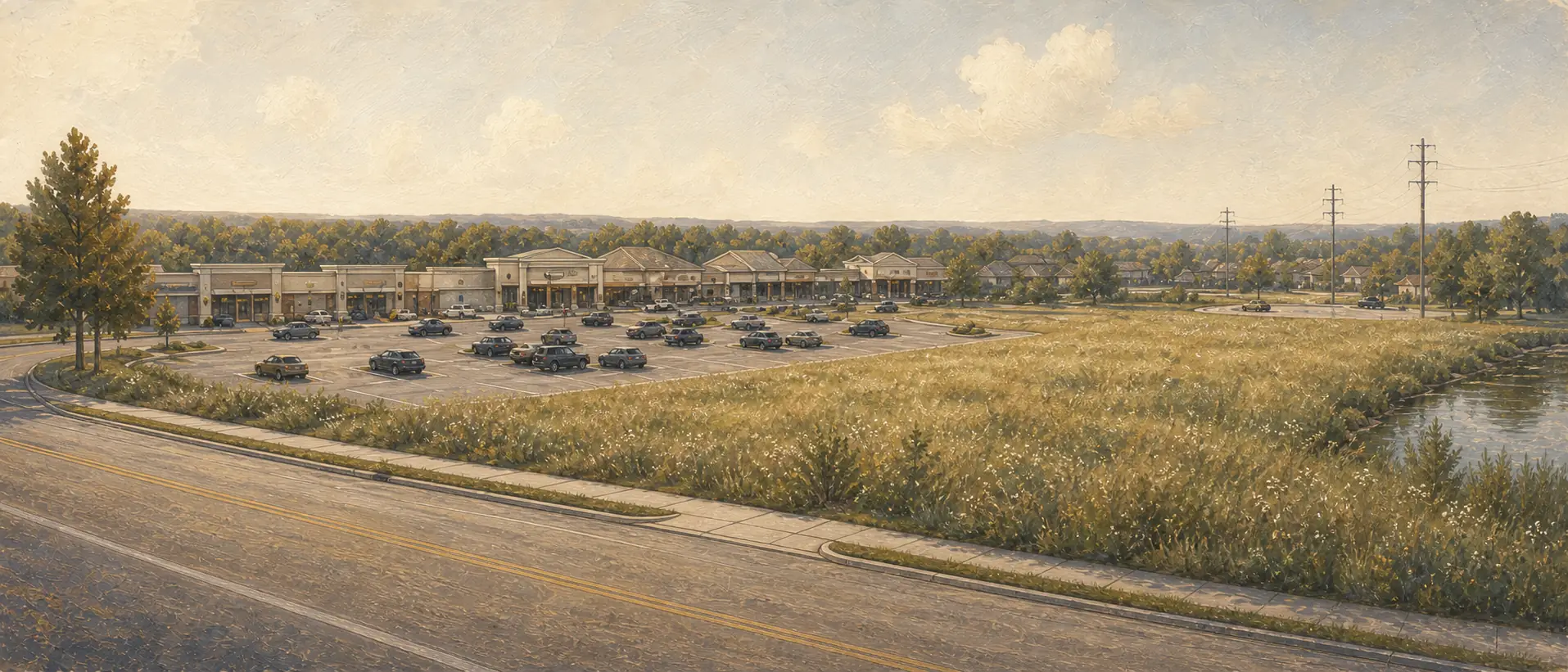
ILLUSTRATION · QSR OUTPARCEL · NOT A SPECIFIC PROPERTYFive pre-LOI questions every QSR pad has to answer. Most of them need confirmation before the LOI goes hard.
The cited site memo is not a traffic study and it is not a civil drawing. It is the site memo that says whether the pad deserves those dollars: can the use operate here, can the stack plausibly fit, what access issue needs traffic confirmation, and what local record says the hearing will care about.
Drive-thru bans
Minneapolis banned all new drive-throughs citywide in 2023. The model is spreading: Providence, Berkeley, and dozens of smaller councils have adopted similar language. Your site may sit in one of them — and your broker won't know.
Minneapolis Burger King →Queue-length denials
In Meridian, Idaho, a projected 40-car queue at peak was the council's stated kill shot. The traffic study existed. The problem was that it confirmed the fear. Queue-stacking is now a primary denial basis — not a footnote.
Meridian In-N-Out →Climate action plan conflicts
Hermosa Beach denied a Starbucks drive-thru on climate grounds — not zoning grounds. If the city has an adopted Climate Action Plan, its planning commission can invoke it as a discretionary denial basis. Few site-selection teams flag this.
Hermosa Beach Starbucks →Big-box and dollar-store moratoria
Dollar General, Dollar Tree, and large-format grocery expansions have triggered protective moratoria in hundreds of small and mid-size markets. If your next Raising Cane's or QSR anchor is near a moratoria-prone jurisdiction, that lease deposit may be in jeopardy.
Edmond Walmart →Streetcar and corridor overlay restrictions
Kansas City denied a McDonald's because the parcel sat inside a streetcar corridor overlay district prohibiting auto-oriented uses. These overlays are invisible in standard GIS layers — they require reading the full adopted zoning code, not the summary.
KC McDonald's streetcar →Why case files predict your next deal
Every known drive-through fight is a pattern your next pad might match.
RealClear’s case files are past events. The product we sell is a cited site memo on a pad before LOI. When we screen your parcel, we ask which known fights it resembles, then verify the local record in a cited-review queue that targets a delivery window confirmed at acceptance of the completed property submission. Complex or thin-record sites can take longer. We flag professional handoff questions instead of pretending a site memo can replace traffic or civil engineering.
Screen a siteQSR and drive-thru case files. Source documents linked.
Planning commission records. Hearing transcripts. Council votes. Staff reports. Every case file cites the primary source so your analyst can pull the document — not just trust the summary.
How we read In-N-Out Meridian.
In-N-Out Burger filed application H-2024-0058 for a conditional use permit at 5985 N. Ten Mile Road in Meridian, Idaho — a 2.22-acre C-G (General Commercial) parcel in a fast-growing suburb where the chain already held an approved drive-thru four miles east on Fairview Avenue. The use was not by-right. Under Meridian’s Unified Development Code §11-4-3-11, every drive-through restaurant in a commercial zone requires a CUP, which means a public hearing, which means the neighbors get a microphone.
What followed was textbook opposition organizing. More than 300 written submissions landed in the city’s record before the Planning and Zoning Commission hearing — a volume that, in Meridian’s experience, is both unusual and meaningful. The opposition coalesced around a small number of arguments that compounded each other: a projected 40-car peak queue that residents said would spill onto Ten Mile Road, late-night operating hours adjacent to the Olivia Townhomes and Apartments, and headlight intrusion into bedroom windows from the stacking lane alignment. None of these arguments were invented at the hearing. They were documented — in past Meridian staff reports, in comparable denials elsewhere in the region, in the public record. The traffic study In-N-Out submitted confirmed the queue projection rather than refuting it.
The Planning and Zoning Commission denied the CUP 4-1. In-N-Out appealed to the Meridian City Council for a de novo hearing — the second bite — and lost again, 5-1. What’s notable in the council math is who voted how, and why. The application had support from one commissioner willing to attach conditions in lieu of outright denial. It did not have enough. The council majority was persuaded by the same residential-proximity and queueing arguments that had moved the commission. The conditions In-N-Out offered — stacking lane adjustments, operational hours modifications — were deemed insufficient mitigation.
The contrast with Raising Cane’s at 2712 N. Eagle Road — approved by the same council under the identical UDC §11-4-3-11 — is instructive. Eagle Road was a different parcel topology: better buffering from residential, a less congested intersection, a site design with longer internal stacking. Same ordinance. Same commission. Different physical facts. Different outcome. The In-N-Out Ten Mile application was not a close call once you read the comparable record. It was a predictable denial that a pre-filing entitlement screen should flag before lease, design, and counsel spend start compounding.
This is the work RealClear does before you file. We read the adopted UDC. We pull comparable applications from the same commission where the record is available. We assemble public submissions, access concerns, residential adjacency, and queue-study implications against the commission’s stated standards. The result is a cited site memo that tells your development team: this is the playbook this jurisdiction may use to deny drive-throughs. You can see it in the record. Now decide whether your site design and timeline can thread that needle — before you spend serious money finding out at a public hearing.
Show us your parcel. We’ve already seen this playbook.
Case outcome
5985 N. Ten Mile Rd
Zoning
C-G (General Commercial)
Pathway
UDC §11-4-3-11
Community Risk
300+ written submissions
Queue Flag
40-car projected peak
Comparable
Eagle Rd Raising Cane's
Outcome
Denied 4–1 at P&Z Commission
Upheld 5–1 by City Council
Application H-2024-0058 · Meridian, ID
Do not put the pad under LOI before the first-pass questions are clear.
100+ municipalities have restricted drive-throughs since 2019. The pad you’re about to pursue may be in one of them. RealClear reads the ordinance, comparable record, access flags, stacking exposure, and traffic-confirmation questions before the LOI clock starts.
Is the use by-right or does it require a CUP? What conditions does this commission routinely attach? Which council members have voted against drive-throughs in the last 24 months? Your IC brief needs answers before LOI, not after the public hearing. That is what QSR & Drive-Thru Risk Site Memos put on one page, each finding tied to the source record.
The review queue targets a delivery window confirmed at acceptance of the completed property submission. Complex or thin-record sites can take longer.
Bring one site and the questions your investment committee needs answered.
Keep reading