Case File
Drive-Thru-Only Chick-fil-A — 6 Public Hearings in One Month
Maryland’s first drive-thru-only Chick-fil-A format faced 6 public hearings in July 2025 alone and a Board of Appeals appeal filed December 2025. A novel format with no state precedent became the entitlement target.
Case File · Arnold, Anne Arundel County, Maryland · 2025
Six hearings. Still no decision. Route 2 is the problem.
Chick-fil-A proposed a drive-thru-only restaurant at 1500 Ritchie Highway in Arnold, Maryland. Adjacent property owners — including Arnold Preservation Council President Elizabeth Rossborg, who lives less than 175 feet from the site — filed an appeal to the Anne Arundel County Board of Appeals. Six hearings later, the Board is still deliberating.
The issue: Route 2 (Ritchie Highway) becomes a seasonally gridlocked Bay Bridge approach corridor. Summer weekends back traffic up for miles. A drive-thru-only concept with no dine-in alternative on this corridor is an acute traffic risk.
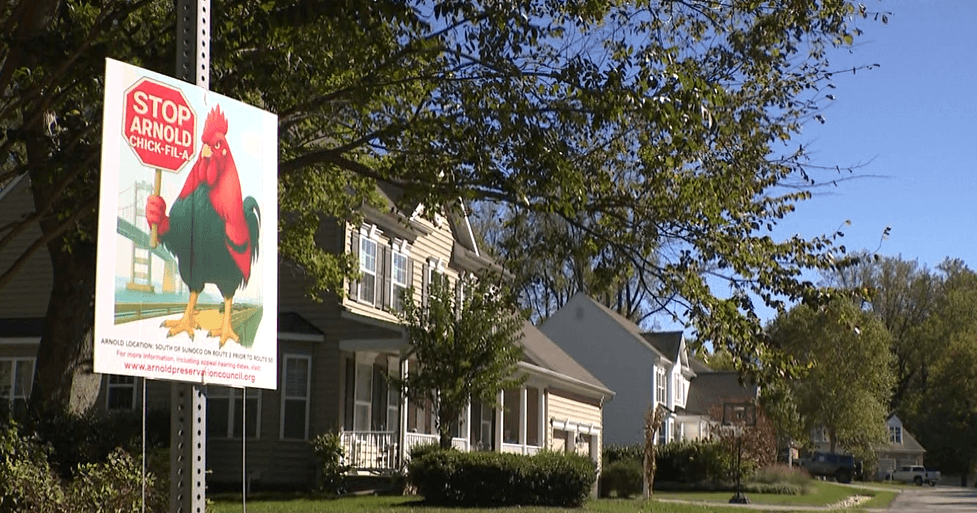
Arnold, MD — Chick-fil-A's drive-through permit denied twice over traffic and character concerns
News coverage
Cited Brief
How RealClear built this assessment.
This source review is backed by a traceable source trail — real articles, real officials, real patterns.
News records reviewed
Officials identified
Comparable approvals reviewed
Opposition groups in record
Event Timeline
Key milestones in the entitlement journey
Early 2025
CUP filed for drive-thru-only Chick-fil-A at 1500 Ritchie Hwy
Jul 2025
Six public hearings in one month — opposition intensifies
Jul 2025
Hundreds of petition signatures collected
Dec 2025
Board of Appeals appeal filed
Early 2025
CUP filed for drive-thru-only Chick-fil-A at 1500 Ritchie Hwy
Jul 2025
Six public hearings in one month — opposition intensifies
Jul 2025
Hundreds of petition signatures collected
Dec 2025
Board of Appeals appeal filed
Key Actors
Decision-makers and their positions
Anne Arundel County Board of Appeals
Appellate Review Body
Hearing the appeal of the drive-thru-only format — no precedent in Maryland for this use type
Neighboring Residents & Businesses
Organized Opposition
Collected hundreds of petition signatures, testified at six hearings on traffic, noise, and corridor character
Opposition Record
Organized opposition groups
Ritchie Highway Corridor Residents
Hundreds of petition signatures
Tactics
Petition drives, six consecutive hearings, traffic study methodology challenges
Track Record
First organized effort in this corridor — forced six hearings in one month and a Board of Appeals escalation
Engagement Strategy
Pre-application meeting with adjacent property owners to address headlight intrusion and stacking concerns. Independent traffic study before filing.
Risk Triggers
What activates opposition
- Drive-thru-only format with no dine-in seating
- Stacking queues onto Ritchie Highway
- Novel use type with no Maryland precedent
Potential Allies
Groups that may support the project
Anne Arundel County Economic Development
Government agency
Job creation and sales tax revenue from national brand
Jurisdiction Pattern
What history tells us about this jurisdiction
Approval history
Drive-thru-only QSR: 0 of 1 attempted in Maryland (no precedent)
Recent Shifts
Novel use type triggered Board of Appeals review rather than standard CUP process
Source read
Drive-thru-only formats with no interior dining have no established precedent in Maryland. Six hearings in one month is a process designed to exhaust the applicant, not evaluate the application.
Cited research compiled from 8 news articles, Anne Arundel County hearing records, and comparable drive-thru-only QSR applications nationwide
Drive-thru-only formats with no interior dining have no established precedent in Maryland
Drive-thru-only formats with no interior dining have no established precedent in Maryland. Six hearings in one month is a process designed to exhaust the applicant, not evaluate the application. Cited research compiled from 8 news articles, Anne Arundel County hearing records, and comparable drive-thru-only QSR applications nationwide
Theme distribution
How this was assembled: Every source record ties to a public source you can verify yourself — news coverage, hearing records, court filings, public testimony. No scraped gated platforms, no invented engagement numbers, no attributions that aren’t on the page. RealClear surfaces source records; your team decides. See our methodology for the full sourcing standard.
RealClear Analysis
Why drive-thru-only on a seasonal corridor is the highest-risk format.
The Arnold case illustrates a compounding risk structure: every individual factor (seasonal corridor, adjacent opposition, environmental impacts) is manageable. Together, they create six hearings and a genuinely uncertain outcome.
Seasonal traffic requires seasonal analysis
Route 2 becomes a Bay Bridge approach road during summer weekends. A traffic study based on annual ADT dramatically understates the peak hours when the drive-thru will generate the most conflicts. Seasonal traffic impact analysis is essential on this corridor.
Adjacent owner with standing is the most dangerous opponent
Elizabeth Rossborg has formal legal standing as an adjacent property owner, organizational credibility as Arnold Preservation Council president, and personal motivation as a neighbor. This is the highest-quality opposition structure — and it was predictable from the site's adjacency map.
Six hearings means the record is genuinely contested
When a Board of Appeals requires six hearings, the factual record is complex and the outcome is not predetermined. This is not a case where the applicant or opponents have a clear-cut advantage. The Board will decide on the evidence.
AA County Planning · Board of Appeals Docket · Traffic Impact Study Route 2 · Arnold Preservation Council
Case Timeline · 2025
Six hearings, still counting.
The Arnold case demonstrates what happens when a well-resourced applicant meets a well-resourced opponent on genuinely contested traffic grounds. Both sides are litigating the record seriously.
Early 2025
Chick-fil-A files preliminary plan for 1500 Ritchie Highway
Chick-fil-A seeks approval to construct a 2,852-square-foot drive-thru-only restaurant at 1500 Ritchie Highway (Route 2) in Arnold, adjacent to a CVS pharmacy and near a major intersection. Anne Arundel County Planning and Zoning approves the preliminary plan — triggering an appeal window for adjacent property owners.
approx.Summer 2025
Elizabeth Rossborg and adjacent owners file appeal
Elizabeth Rossborg, President of the Arnold Preservation Council, who lives less than 175 feet from the proposed site, files an appeal of the preliminary plan approval with the Anne Arundel County Board of Appeals. She is joined by other adjacent property owners. The Stop Arnold Chick-Fil-A public coalition organizes. The appeal grounds: traffic safety, pedestrian hazards, removal of specimen trees, and impervious surface increase.
approx.September 2, 2025
First of six Board of Appeals hearings
The Anne Arundel County Board of Appeals holds the first hearing on the appeal. The cases involves traffic safety analysis on Route 2 — a corridor that experiences severe seasonal gridlock from Bay Bridge beach traffic. This is not a routine arterial; it is a seasonally overwhelmed highway where adding a drive-thru generates acute peak-hour conflict.
approx.September–October 2025
Additional hearings — technical testimony on traffic and environmental impacts
Multiple additional hearings address the traffic study methodology, the pedestrian safety concerns on Ritchie Highway, the specimen tree impact assessment, and the stormwater implications of increased impervious surface. Chick-fil-A presents traffic engineering rebuttal. Opponents retain independent traffic consultants.
approx.November 13, 2025
Board rejects bias claim against member Estepp
Opponents argue that Board member James Estepp harbors a pro-Chick-fil-A bias that disqualifies him from the proceedings. The full Board unanimously rejects the bias argument — ruling Estepp may participate. The ruling reflects a high bar for bias disqualification in quasi-judicial administrative proceedings.
approx.December 4, 2025
Sixth hearing — closing arguments submitted
The Board of Appeals holds its sixth and final hearing. Chick-fil-A's counsel presents a rebuttal to all opponent arguments. The parties submit written closing statements. Under Anne Arundel County procedure, the Board has 60 days from receipt of closing statements to issue its written decision.
approx.Early–Mid 2026
Board of Appeals decision expected
The Board's decision is expected in early to mid 2026. The six-hearing process reflects the depth of contested factual issues — particularly the traffic impact analysis and the Route 2 seasonal congestion baseline. Whatever the outcome, the decision will set precedent for how Anne Arundel County evaluates drive-thru-only QSR applications in corridor contexts.
approx.
Key Officials & Stakeholders
Who is fighting this. And why.
Elizabeth Rossborg
Lead Appellant / Arnold Preservation Council President
Adjacent property — <175 feet from site
Documented Record
Filed appeal as Arnold Preservation Council president and adjacent property owner (<175 feet from site), citing traffic congestion concerns, removal of specimen trees, and increased impervious surface runoff.
Rossborg is a precisely positioned opponent: credible (Preservation Council president), personally affected (lives <175 feet from site), and raising documented substantive issues (not merely NIMBY character arguments). Her combination of organizational credibility and proximity makes her the most effective type of appeal filer.
Anne Arundel County Board of Appeals
Quasi-Judicial Appeals Body
Six-Hearing Process — 2025
Documented Record
Scheduled six hearings to evaluate all evidence against applicable preliminary plan approval standards. Rejected bias challenge (Estepp ruling), maintaining procedural integrity of the review.
The Board's commitment to a six-hearing process reflects the genuine complexity of the traffic and environmental record. The bias rejection (Estepp ruling) suggests the Board is functioning as intended — focused on evidence, not political pressure. The outcome genuinely depends on the merits.
Chick-fil-A
Applicant
1500 Ritchie Highway (Route 2)
Documented Record
Submitted traffic study asserting the proposed restaurant can be accommodated within existing Route 2 traffic patterns. Application claims site meets all county development standards for preliminary plan approval.
Chick-fil-A's position depends heavily on its traffic study — which opponents are contesting with independent analysis. The drive-thru-only format is particularly vulnerable to traffic-focused appeals because there is no alternative (dine-in) use that could offset drive-thru volume.
Stop Arnold Chick-Fil-A Coalition
Community Opposition Organization
Public coalition + adjacent residents
Documented Record
Organized opposition through a public coalition and adjacent resident network, citing Route 2 summer beach traffic gridlock and projected neighborhood impact from drive-thru-only restaurant format.
The coalition's Route 2 seasonal traffic argument is their strongest card. Chick-fil-A's traffic study likely uses average daily traffic (ADT) — which dramatically underweights peak summer weekend conditions when Route 2 backs up for miles approaching the Bay Bridge.
Primary Source Documents
8 DocumentsEvery finding cited to the source. Click any document to preview it directly. Source-record patterns visible to experienced entitlement analysts months before the hearing.
RealClear
Identify adjacent owner standing risk before the preliminary plan.
RealClear maps adjacent property owners, identifies formal appeal standing, and flags seasonal traffic corridors — before you file anything that can be appealed.