Case File
Google Withdrew Its Franklin Township Data Center Before the Council Vote
467.66 acres of Franklin Township farmland. Organized opposition built through the hearing process. Google withdrew before the council vote.
Case File · Franklin Township, Indianapolis, Indiana
$1 billion withdrawn before the vote.
Google, operating through Deep Meadow Ventures LLC, filed to rezone 467.66 acres of Franklin Township farmland for a proposed data center campus. After clearing MDC 8-1 and heading toward a hostile full-council vote, the petition was withdrawn on September 22, 2025.
Cited site read: 2/100 before full diligence and land-assembly spend accelerated.
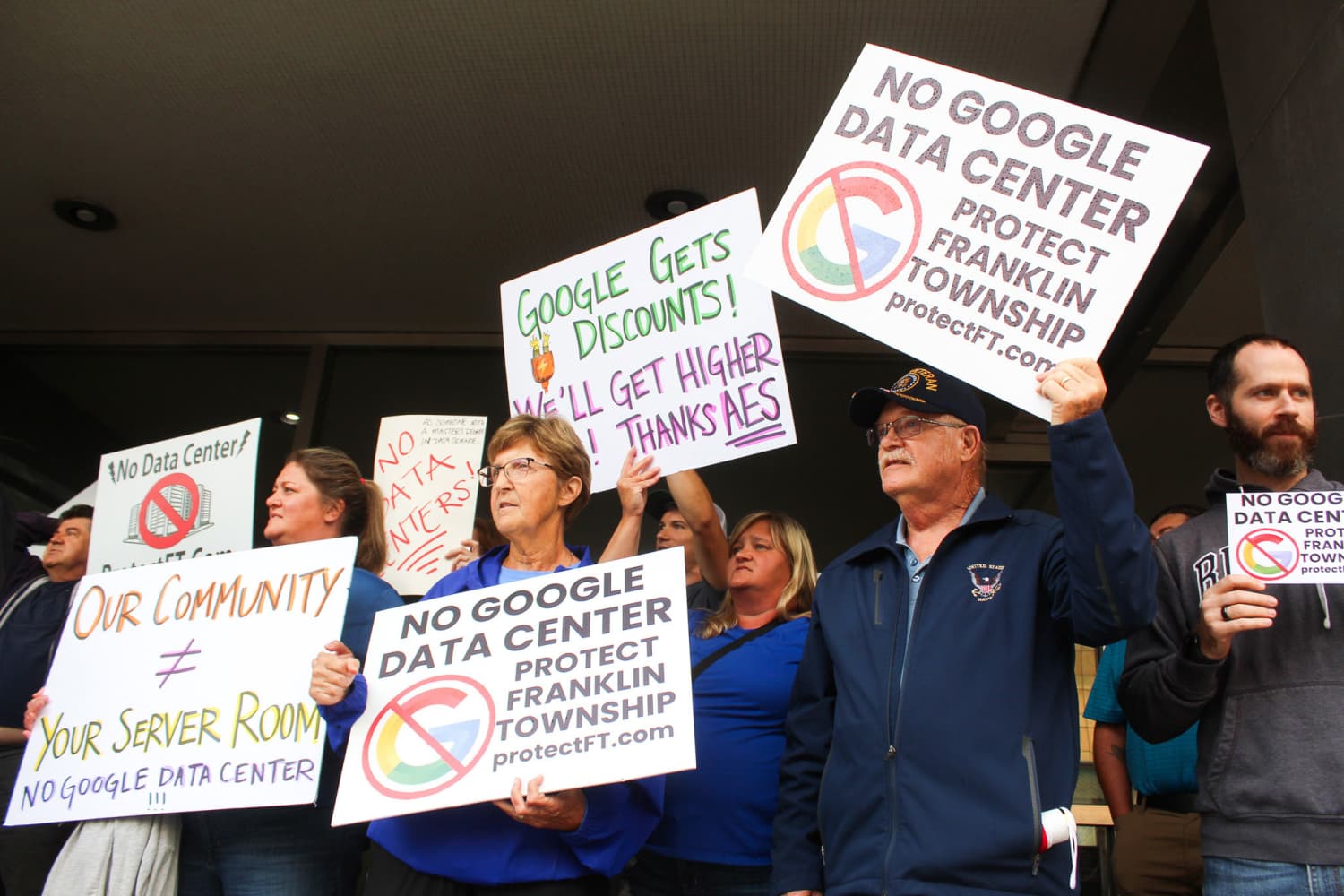
Indianapolis City-County Council chambers — hundreds cheered when Google withdrew minutes before the vote
WFYI / Farrah Anderson
~$1B
Reported Scale
467.66 ac
Acreage
8-1
MDC Vote
Call-Down
Council Path
Withdrawn
Outcome
2/100
RealClear Score
Franklin Township, Indianapolis · Summer 2024 — October 2025
The complete timeline.
Every verified decision point in the 2025 Franklin Township rezoning fight.
- Pre-Filing
- Regulatory Process
- Community Opposition
- Withdrawal
- Aftermath
2024–early 2025
Landowners are approached through a confidential assemblage process
Local reporting later described landowners being approached through confidentiality agreements before Google's identity became public. By the time the petition was filed, Deep Meadow Ventures LLC had targeted a 467.66-acre footprint.
approx.March 2025
Rezoning Petition 2025-CZN-814 filed
Deep Meadow Ventures LLC files to rezone 467.66 acres from D-A / C-4 / SU-43 with FF/FW overlays to C-S in Franklin Township.
approx.April 10, 2025
The case appears on the hearing examiner agenda
Official Indianapolis hearing records show petition 2025-CZN-814 in the hearing-examiner process by April 10, 2025.
June 12, 2025
Public hearing opens and the case is continued
Official results show the June 12 hearing occurred and that the petition was continued to June 26 after public testimony and remonstrance.
June 26, 2025
MDC Hearing Examiner recommends approval
The hearing examiner recommends approval, but that recommendation does not end the fight. Organized remonstrance continues into the commission and council stages.
July 2025
Google's identity becomes public in local reporting
Public-record reporting connects Deep Meadow Ventures LLC to Google, collapsing the anonymity that had surrounded the filing.
approx.August 20, 2025
MDC approves the rezoning 8-1
The Metropolitan Development Commission approves the petition 8-1. Google still faces the separate political risk of a council call-down and full council vote.
August–September 2025
Formal remonstrance and council opposition harden
Opponents keep filing remonstrance materials and lobbying councilors. By September, the petition is clearly heading toward a hostile full-council vote rather than a quiet administrative close.
September 22, 2025
Google withdraws before the council vote
Before the scheduled council vote, petition counsel announces that Deep Meadow Ventures LLC is withdrawing the proposal. Local reporting describes packed chambers and a visibly organized opposition turnout.
October 1, 2025
Formal withdrawal follows in the record
The petition is formally withdrawn after the September 22 meeting, closing the Franklin Township filing without a final council denial.
The People Who Decided This Case
Key officials and community leaders.
Every actor shown here has a documented role in the record or in contemporaneous reporting.
Michael-Paul Hart
City-County Councilor (R)
District 20 — Franklin Township
Documented Record
Hart publicly opposed the rezoning and used the council call-down process to force the petition to a full council vote.
Once the district councilor opposed the petition, MDC approval stopped being enough.
Joseph D. Calderon
Attorney, Barnes & Thornburg LLP
Petitioner's Counsel
Documented Record
Calderon filed the petition materials for Deep Meadow Ventures LLC, confirmed Google's identity during the August 20 MDC hearing, and announced the withdrawal before the September 22 council vote.
He is the cleanest procedural witness on the applicant side because his actions line up with the formal record.
Protect Franklin Township
Resident opposition coalition
Documented Record
Local coverage identified Protect Franklin Township as a visible organizing hub during the summer 2025 opposition campaign.
The coalition turned neighborhood frustration into a sustained campaign rather than one noisy hearing.
Franklin Township Civic League
Longstanding local civic organization
Documented Record
The civic league participated in questions, hearings, and opposition materials during the rezoning fight.
Its involvement gave the opposition institutional credibility beyond a newly formed petition group.
Franklin Township Schools
School district leadership
Documented Record
Late-stage reporting described the district's position shifting as school-finance concerns entered the debate shortly before the vote.
School-finance arguments complicated the politics, but they did not rescue the petition.
Opposition Record
Local coalition. Civic league. Statewide pressure.
The opposition was not just one angry hearing. It formed through local residents, a longstanding civic organization, and a broader Indiana debate about data centers and utility costs.
Protect Franklin Township
Local resident coalition formed during the rezoning fight
Primary OppositionVisible Organizer
Andrew Filler
Public Record
Hearings, remonstrance, council outreach
Core Issues
Farmland, flooding, infrastructure
Tactics Deployed
Citizens Action Coalition (CAC)
Statewide consumer advocacy · citact.org · Program Director: Ben Inskeep
Statewide InfrastructureProvided statewide utility-cost framing and organizational support that connected the Franklin Township fight to Indiana's broader data center backlash.
Documented Role
CAC appears in reporting and public events as part of the statewide push to connect data-center growth with household electric bills and infrastructure strain.
Franklin Township Civic League
ftcivicleague.org · Land Use Committee Chair: Cathy Burton · Meets 3rd Wednesday at Wanamaker
Civic InfrastructureLongstanding township civic organization that provided established community credibility. The league participated in questions, hearings, and opposition materials during the rezoning process, giving the campaign legitimacy beyond a newly formed resident group.
The Key Differentiator
Public source records that existed before Google filed.
Every one of these source-record factors was visible in public data in March 2025 — before a single petition document was drafted. This is what pre-filing community-risk research looks like.
Farmland Identity Was Central
Formal remonstrance materials and local coverage show that farmland preservation and semi-rural character were central objections from the start. This was not a neutral industrial corridor.
Existing Flooding Problems
Residents and remonstrance materials raised flooding concerns, and the FF/FW overlays on the petitioned parcels made stormwater a record issue rather than just a talking point.
AES Rate Hike as Political Accelerant
Indiana utility-cost politics were already active in 2025. Opponents tied hyperscale power demand to household electric bills, giving the project a ready-made statewide talking point.
Statewide Data-Center Opposition Already Existed
Statewide advocacy around Indiana data-center growth already existed before Franklin Township exploded. That meant local opponents did not have to invent a message from scratch.
School Finance Could Cut Both Ways
School funding became a late-stage pressure point when the district's position shifted. Even if that created a potential ally, it did not cure the broader political opposition.
Republican District + Call-Down Mechanism
District-councilor opposition created a serious risk of a full-council vote. Once that happened, the project moved from technical entitlement into an overt political campaign.
The Pre-Filing Research
What RealClear finds at Deep Meadow Ventures LLC, Franklin Township.
Before a single acre is assembled. Before a single shell company is formed. Before a single planning commissioner hears the words “data center.”
Marion County zoning · Petition 2025-CZN-814 · hearing examiner records · August 2025 remonstrance · September 22 withdrawal reporting
The Pre-Flight Checklist
Six source-record factors. All publicly available.
Every risk that killed this project was visible in public records before a single acre was acquired. RealClear reads those records so your team doesn't have to.
March 2025 — At Filing
25/100
Structural risk only: agricultural zoning requiring full rezoning, flood overlays on parcels, council call-down mechanism as second veto point. No organized opposition yet visible.
August 2025 — Pre-Withdrawal
2/100
Structural risk plus organized opposition, AES rate-hike framing, 17 of 25 councilors publicly opposed, Protect Franklin Township mobilized, 2,400+ petition signatures.
Cited reads evolve as new source records enter the public record. The March cited read marked this site for elevated review. The August cited read pointed to withdrawal.
01
Flood overlay zones on the parcels
County GIS DataThe (FF) and (FW) suffixes on the zoning designations — visible in Marion County GIS data and the petition filing itself — put flood conditions on the table before the hearing process really began. That made flooding a documented regulatory concern, not a surprise attack at the podium.
02
Existing statewide data-center opposition infrastructure
Advocacy recordStatewide groups were already framing Indiana data centers around utility costs and rural land-use impacts. A cited community-risk review surfaces that Franklin Township was unlikely to fight alone.
03
District councilor call-down risk
Political AnalysisThe Indianapolis City-County Council's call-down mechanism meant MDC approval was never the last stop. If the district councilor opposed the petition, the project was headed into a much more political forum.
04
AES Indiana rate hike as political accelerant
IURC DocketUtility-cost politics were already active in Indiana. In Franklin Township, that let opponents frame power demand as a household-bill issue rather than a distant infrastructure discussion.
05
School-finance pressure could cut both ways
Fiscal AnalysisSchool funding emerged late as a pressure point. A team that understood that dynamic early could model whether it created a genuine ally or just a late political complication.
06
NDA strategy risk — communities now check beneficial ownership
Entity AnalysisThe shell-company approach is standard practice for hyperscale site selection, but it can backfire once the real sponsor becomes public. In this case, secrecy fed distrust rather than reducing resistance.
The total cost of this entitlement failure:
Land assembly on 467.66 acres of Indiana farmland. Barnes & Thornburg attorney fees at partner rates. Shell company formation. 14 months of senior development team time. Construction team on standby. And the opportunity cost of a project scored 2/100.
A RealClear analysis costs less than one hour of attorney time.
What Happened Next
The aftermath.
Franklin Township set a precedent. Every subsequent data center developer in Indianapolis either learned from it or ignored it.
Google's Pivot
Other Indiana Filing
After the Franklin Township withdrawal, reporting quickly turned to other Indiana options for Google, including Morgan County. The lesson was obvious: once a rezoning path collapses in one jurisdiction, hyperscale developers go shopping for a friendlier one.
The Lesson Applied
Sabey's Variance Workaround
Later Indianapolis-area data-center strategies showed the same basic lesson: if you can avoid a politically explosive rezoning path, you should. Google's Franklin Township filing made the cost of getting that pathway wrong painfully obvious.
Indiana Legislature
No Statewide Framework Passed
Despite six counties enacting data center moratoriums, state lawmakers took minimal action. HB 1333 (1% local share of sales tax exemptions) passed the House 54-45 but stalled in the Senate. HB 1245 (IURC study) never advanced past first reading. No comprehensive framework emerged.
The Ripple Effect
Other Indianapolis Proposals
Franklin Township was not an isolated event. Other Indianapolis-area data-center proposals also encountered organized neighborhood resistance, reinforcing that local political risk had become a recurring part of the market.
Primary Source Documents
12 DocumentsEvery finding cited to the source. Click any document to preview it directly. Source-record patterns visible to experienced entitlement analysts months before the hearing.
Cited Brief
How RealClear built this assessment.
This source review is backed by a traceable source trail — real articles, real officials, real patterns.
News records reviewed
Officials identified
Comparable approvals reviewed
Opposition groups in record
Event Timeline
Key milestones in the entitlement journey
Mar 2025
Deep Meadow Ventures LLC files a 467.66-acre rezoning petition
Apr 10, 2025
Case appears on the hearing examiner agenda
Jun 12, 2025
Hearing examiner results continue the case to June 26
Jun 26, 2025
Hearing examiner recommends approval
Aug 20, 2025
MDC approves the rezoning and forwards it to City-County Council
Sept 22, 2025
Google withdraws before the council vote
Mar 2025
Deep Meadow Ventures LLC files a 467.66-acre rezoning petition
Apr 10, 2025
Case appears on the hearing examiner agenda
Jun 12, 2025
Hearing examiner results continue the case to June 26
Jun 26, 2025
Hearing examiner recommends approval
Aug 20, 2025
MDC approves the rezoning and forwards it to City-County Council
Sept 22, 2025
Google withdraws before the council vote
Key Actors
Decision-makers and their positions
Michael-Paul Hart
City-County Councilor, District 20
District 20's councilor opposed the rezoning and forced it into the City-County Council process after MDC approval
Protect Franklin Township
Community Opposition Group
Organized public opposition as the rezoning moved from the hearing examiner to MDC and then council review
Joseph D. Calderon / Deep Meadow Ventures LLC
Petitioner's counsel and applicant
Filed the rezoning petition, represented Deep Meadow Ventures LLC at hearings, and announced the withdrawal before the council vote
Opposition Record
Organized opposition groups
Protect Franklin Township
Hundreds attended council hearings
Tactics
Public testimony, petitions, agricultural character framing, and remonstrance filings
Track Record
Sustained opposition through the hearing examiner, MDC, and council stages until the applicant withdrew
Jurisdiction Pattern
What history tells us about this jurisdiction
Approval history
Agricultural-to-data-center rezoning outcomes in Indiana vary and have not been independently verified as a complete comparable set
Recent Shifts
The Franklin Township file shows how an MDC approval can still unravel once a council call-down and organized opposition collide
Source read
The official record is strongest on process, acreage, flood overlays, and the withdrawal date. Claims about exact vote counts and statewide advocacy track records require caution and should not be presented as settled fact.
Cited research compiled from MDC agendas and results, the Aug. 20 certification and remonstrance record, Indianapolis zoning code materials, and supporting reporting on the withdrawal.
Franklin Township's public record for the $1B Google data center rezoning reached withdrawal within six months of the first organized civic response.
Reporting across Mirror Indy, WTHR, WFYI, and Data Center Dynamics documents a citizens' coalition that coalesced around water use, utility-rate fairness, and farmland preservation — visible in the public record months before Google withdrew its petition in September 2025. Three civic participants — a district councilor, a citizens' coalition organizer, and a statewide utility advocate — carried the critical-stance narrative in the public record through to the pre-vote withdrawal.
Theme distribution
Record questions still open: No gated neighborhood-platform record is included in this case file. The municipal comment record and cited local coverage carry the stronger signal.
How this was assembled: Every source record ties to a public source you can verify yourself — news coverage, hearing records, court filings, public testimony. No scraped gated platforms, no invented engagement numbers, no attributions that aren’t on the page. RealClear surfaces source records; your team decides. See our methodology for the full sourcing standard.
Source review generated 2026-04-12
Decision Framework
What a disciplined team would do differently.
Three decision points. Each one changes the outcome.
01
If screening this jurisdiction
Franklin Township’s D-A agricultural zoning required full rezoning with flood overlay complications. The council call-down mechanism meant MDC approval was never the final gate. RealClear’s Approval path review surfaces this as a two-veto-point jurisdiction before the petition was filed. Recommendation: screen for jurisdictions where the zoning body’s approval IS the final approval.
02
If committed to this site
Pre-engage District 20 Councilor Hart and key council members before filing. Address the AES rate-hike framing proactively — show community economic benefit beyond tax revenue. Avoid shell-company land assembly in a jurisdiction where beneficial-ownership transparency is becoming a political issue. Budget 6–9 months for community engagement before the first hearing.
03
Pattern for similar sites
Agricultural-to-industrial rezonings for data centers in township governance require explicit community engagement before filing. Shell-company anonymity backfires once identity is revealed. Utility-cost framing (household bills, water, power) is now the dominant opposition argument in 14 of 23 documented data center fights. Pre-address it or lose.
This Is Entitlement Research
Screen a site for your next project.
This page is what entitlement research looks like. Every risk. Every actor. Every source-record factor — surfaced before you spend a dollar on land assembly, attorneys, or consultants.
RealClear runs a full entitlement risk analysis — zoning, approval pathway, community opposition, comparable outcomes, and political signals — fully analyzed. Before any land is assembled. Before any attorney is engaged.
Cited research summary · Not legal advice · Verify independently before making investment decisions