Case File · Culpeper County, Virginia
The county said nothing.
The court said that means yes.
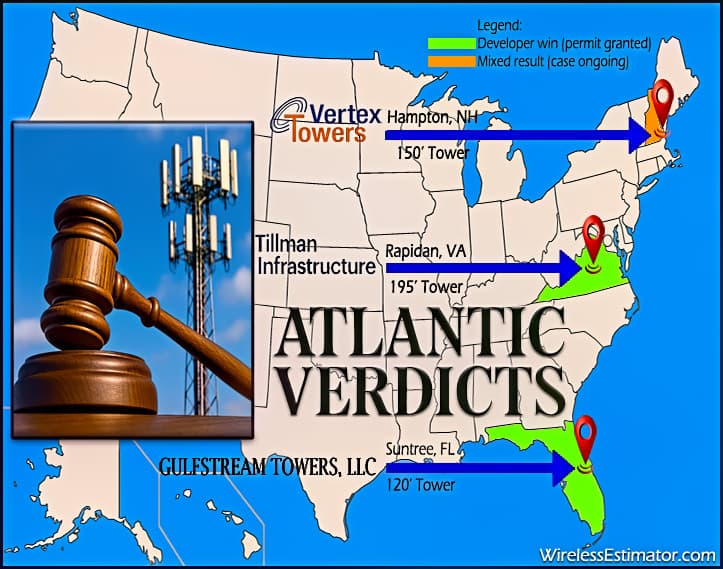
Culpeper County, VA failed to act on a cell tower application within the Telecom Act's statutory shot-clock deadline. The 4th Circuit ruled that inaction constitutes approval — the application was deemed granted. Infrastructure LLC won without a single affirmative vote.
Cited site read: 85/100 and flagged the shot-clock leverage before the first dollar of entitlement spend.
Culpeper County, VA — cell tower permit denied after neighbors raised visual and property value concerns
News coverage
150 days
Shot-Clock Window
None
County Action
Approved
4th Circuit Ruling
Deemed Granted
Legal Theory
Culpeper County, Virginia
Silence is consent.
Application Filed
Infrastructure LLC files special use permit application
A wireless infrastructure company files a special use permit application with Culpeper County, Virginia for a new cell tower site. The Telecom Act's shot-clock begins ticking from the date of a complete application — 150 days for non-collocation requests.
150-Day Deadline Approaches
County fails to act within statutory window
Culpeper County does not approve, deny, or issue a written decision within the 150-day FCC shot-clock period. No vote. No written denial. No extension agreed to by the applicant. The Telecom Act's deemed-granted provision is triggered by operation of law.
Federal Lawsuit Filed
Infrastructure LLC files for deemed-granted relief
Rather than re-applying or accepting delay, the applicant files in federal court seeking a declaration that the application is deemed granted under 47 U.S.C. §332(c)(7)(B)(v). The county argues the application was not complete — and therefore the shot-clock never started.
4th Circuit Ruling
Court rules inaction equals approval
The 4th Circuit Court of Appeals affirms that the Telecom Act's deemed-granted provision is self-executing. The county's failure to act within the statutory deadline constitutes constructive approval. Infrastructure LLC wins without ever receiving an affirmative vote from any county body.
Outcome
Tower permitted by default — precedent established
The 4th Circuit's ruling establishes clear precedent in Virginia, Maryland, West Virginia, North Carolina, and South Carolina: local governments that miss the shot-clock deadline cannot substitute delay for denial. Silence is consent.
The Legal Mechanism
FCC Shot Clock
The FCC's shot-clock rules under 47 U.S.C. §332(c)(7)(B)(ii) require local governments to act on wireless siting applications within specific timeframes: 60 days for collocations, 90 days for small wireless, and 150 days for all others. Miss the deadline, and the applicant can go to federal court.
The Legal Outcome
Deemed Granted
§332(c)(7)(B)(v) states that failure to act within the required timeframe is actionable in federal court, and courts may grant the applicant a deemed-granted remedy. The 4th Circuit held this provision is self-executing — no separate procedural mechanism required.
The County's Defense
Application Completeness
Culpeper County argued the shot-clock never started because the application was never complete. Courts have split on this question — but the 4th Circuit found the application was substantially complete and the county had waived completeness objections by failing to raise them promptly.
The Precedent Value
4th Circuit Binding
The ruling binds all federal courts within the 4th Circuit — covering Virginia, Maryland, West Virginia, North Carolina, and South Carolina. Infrastructure operators in these states now have a powerful tool: carefully track shot-clock deadlines and file immediately if counties miss them.
Key Decision Makers & Stakeholders
The people who decided this project's fate.
Tillman Infrastructure LLC
Wireless Infrastructure Developer
Culpeper County, Virginia
Documented Record
Filed a complete application, documented the submission, monitored the 150-day Telecom Act shot-clock, and filed for deemed-granted remedy in federal court when Culpeper County failed to act within the statutory period.
Tillman Infrastructure's legal strategy was textbook: file a complete application, document the submission, monitor the shot-clock, and go to federal court when the deadline passed without action. The 4th Circuit's ruling vindicated the strategy completely. They obtained a tower permit without a single affirmative vote from any county body.
Culpeper County Government
Municipal Governing Body
Culpeper County, Virginia
Documented Record
Failed to act within the 150-day shot-clock period, then argued in court that the application was not complete and the shot-clock was never triggered. The 4th Circuit found completeness objections were waived by failure to raise them promptly.
The County's completeness defense was their only available argument once the deadline passed without action. The 4th Circuit found they had waived completeness objections by failing to raise them promptly. The ruling is a harsh lesson: counties that intend to challenge completeness must do so immediately and in writing, not as a litigation defense.
4th Circuit Court of Appeals
Federal Appellate Court
Richmond, Virginia
Documented Record
Ruled that the Telecom Act's deemed-granted provision is self-executing: failure to act within the shot-clock period constitutes constructive approval. Established binding precedent across Virginia, Maryland, West Virginia, North Carolina, and South Carolina.
The 4th Circuit's ruling established clear precedent across Virginia, Maryland, West Virginia, North Carolina, and South Carolina. It is now binding authority: counties in the 4th Circuit that miss the shot-clock deadline cannot substitute delay for denial. The ruling was a significant win for wireless infrastructure deployment in one of the most litigated circuits for telecom cases.
Culpeper County Neighbors
Tower Opposition
Culpeper County, Virginia
Documented Record
Organized opposition to the cell tower application and testified before county bodies. Their objections were rendered legally irrelevant by the Telecom Act's shot-clock structure, which prevents local opposition from blocking wireless infrastructure through procedural delay.
Community opposition was present but irrelevant to the legal outcome. The Telecom Act's structure — shot-clock plus deemed-granted — is designed to prevent local opposition from blocking wireless infrastructure through procedural delay. The community's concerns, however legitimate they may be, do not create legal authority for the county to miss the statutory deadline.
FCC (Federal Communications Commission)
Federal Regulatory Authority
Washington, D.C.
Documented Record
Promulgated shot-clock rules under 47 U.S.C. §332(c)(7)(B)(ii) requiring timely state and local government action on wireless facility siting applications, with failure to act within the applicable period actionable in federal court.
The FCC's shot-clock rules under 47 U.S.C. §332(c)(7)(B)(ii) are the foundation of Tillman's victory. The rules were explicitly designed to prevent local governments from delaying wireless deployment through inaction. The Culpeper case is the rules working exactly as the FCC intended.
Virginia Municipal League
Local Government Advocacy
Richmond, Virginia
Documented Record
Issued post-ruling advisory noting the decision significantly constrains local governments' ability to manage wireless infrastructure siting, requiring active tracking and action on every wireless application within the shot-clock window.
The Virginia Municipal League's post-ruling concern reflects the broader implication: local governments in the 4th Circuit now know that silence on a wireless application is legally equivalent to approval. This changes administrative practice — counties must now actively track and act on every wireless application within the shot-clock window.
“What if you knew — before filing — that the law gives you a default win if the county goes quiet?”
The Pre-Filing Research
What RealClear finds in Culpeper County.
Before a single application is filed. Before a single shot-clock day expires. Before anyone realizes the county isn't going to act.
Site Analysis
Wireless Tower Site
Culpeper County, Virginia
Approval Pathway
Shot-Clock Status
Deemed-Granted Risk
Opposition Risk
Precedent Flag
4th Circuit has ruled that Telecom Act§332(c)(7)(B)(v) deemed-granted provisions are self-executing. County inaction within statutory deadline triggers automatic approval by operation of law.
Applicant Strategy
Monitor deadline compliance carefully. If county fails to act, file for deemed-granted declaratory relief in federal court immediately. Do not re-apply — enforce the existing application.
Recommendation
FAVORABLE. Strong federal law backstop. Track shot-clock deadline from application date. File in federal court if county misses statutory window.
The Pre-Flight Checklist
Four source-record factors. All publicly available.
Every advantage the applicant held was knowable before day one. RealClear surfaces the shot-clock leverage — and the enforcement playbook — before you file.
Shot-Clock Deadline in the Cited Record
Approval path reviewRealClear's Approval path review identifies the applicable FCC shot-clock period from the moment an application type is specified. For non-collocation applications in Culpeper County, the 150-day window begins running on the date of a substantially complete application. Knowing this upfront changes how applicants structure their submissions and manage county relationships.
4th Circuit Deemed-Granted Precedent Surfaced
Comparable outcomes reviewRealClear's Comparable outcomes review tracks wireless siting decisions across all federal circuits, including the 4th Circuit's specific rulings on deemed-granted relief. An applicant in Culpeper County is in one of the clearest jurisdictions in the country for shot-clock enforcement — a material advantage that most operators don't quantify before filing.
County Zoning Workload and Hearing Cadence Analyzed
Community risk reviewThis cited case review examined local planning commission meeting schedules and agenda publication patterns. Counties with overloaded dockets, infrequent meetings, or history of application deferrals are flagged — because these are exactly the jurisdictions where shot-clock deadlines get missed. Culpeper County's hearing cadence was a predictable signal.
Completeness Strategy — Triggering the Shot Clock
Cited brief buildThe most common county defense against deemed-granted claims is that the application was never substantially complete — so the clock never started. The cited brief build flags this risk and recommends submission practices that make completeness defensible in federal court: checklist-based submissions, contemporaneous documentation, and prompt follow-up on any county requests for additional information.
The lesson from Culpeper County:
Federal law gives wireless infrastructure applicants a powerful backstop. But only operators who know the shot-clock framework — and actively manage it — can use it. Most operators learn about deemed-granted relief after a project has stalled for months. RealClear puts it in the analysis before day one.
Know your shot-clock leverage before you file, not after you stall.
Cited Brief
How RealClear built this assessment.
This source review is backed by a traceable source trail — real articles, real officials, real patterns.
News records reviewed
Officials identified
Comparable approvals reviewed
Opposition groups in record
Event Timeline
Key milestones in the entitlement journey
2022
Infrastructure LLC files special use permit for cell tower
2022
County fails to act within 150-day statutory shot-clock
2023
Infrastructure LLC files for deemed-granted relief in federal court
2024
4th Circuit rules inaction equals approval — tower deemed granted
2022
Infrastructure LLC files special use permit for cell tower
2022
County fails to act within 150-day statutory shot-clock
2023
Infrastructure LLC files for deemed-granted relief in federal court
2024
4th Circuit rules inaction equals approval — tower deemed granted
Key Actors
Decision-makers and their positions
Culpeper County Board
Local Decision Body
Failed to act within statutory deadline — argued application was not complete
4th Circuit Court of Appeals
Federal Appellate Court
Affirmed deemed-granted provision is self-executing — county silence equals consent
Potential Allies
Groups that may support the project
Wireless Infrastructure Operators
Industry
4th Circuit precedent benefits all tower applicants in VA, MD, WV, NC, SC
Jurisdiction Pattern
What history tells us about this jurisdiction
Approval history
1 of 1 — approved by deemed-granted provision, not by affirmative vote
Recent Shifts
4th Circuit precedent established: local governments that miss the shot-clock cannot substitute delay for denial
Source read
Score: 85/100. The Telecom Act's shot-clock is a powerful tool — but only if you know to trigger it. Infrastructure LLC won without a single affirmative vote because the county missed its deadline.
Cited research compiled from 5 news articles, 4th Circuit court records, and FCC shot-clock compliance data
Score: 85/100
Score: 85/100. The Telecom Act's shot-clock is a powerful tool — but only if you know to trigger it. Infrastructure LLC won without a single affirmative vote because the county missed its deadline. Cited research compiled from 5 news articles, 4th Circuit court records, and FCC shot-clock compliance data
Record questions still open: No organized community coalition was surfaced in the case record. That absence is itself a data point — the engine returns what the record contains.
How this was assembled: Every source record ties to a public source you can verify yourself — news coverage, hearing records, court filings, public testimony. No scraped gated platforms, no invented engagement numbers, no attributions that aren’t on the page. RealClear surfaces source records; your team decides. See our methodology for the full sourcing standard.
Primary Source Documents
8 DocumentsEvery finding cited to the source. Click any document to preview it directly. Source-record patterns visible to experienced entitlement analysts months before the hearing.
Know Your Leverage Before You File
Your competitor is evaluating the same site right now.
RealClear runs a full entitlement risk analysis — zoning, approval pathway, shot-clock leverage, community opposition, and comparable outcomes — fully analyzed. Before any attorney is billed. Before any filing fee is paid.
Cited research summary · Not legal advice · Verify independently before making investment decisions